01
Home
A standalone page — no sub-sections.
Industrial packaging is not a sentimental business. So we keep our mission short, our rules concrete, and our reporting transparent.
Tell us what you need or what you have. We respond within one business day, every business day.
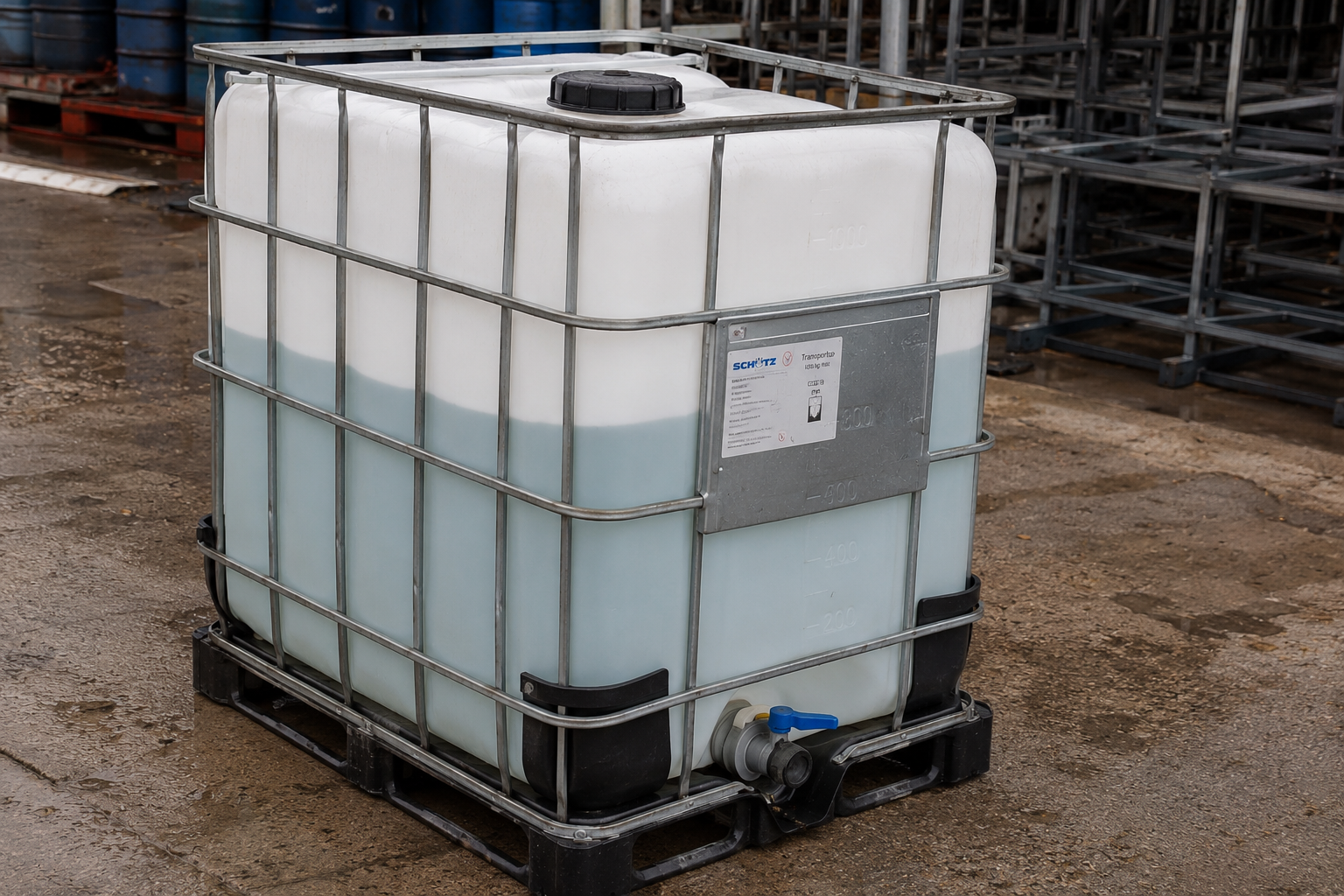
To make the second life of an IBC tote more economical, more available, and more accountable than the first — until specifying a new tank for a job a reused one can do becomes the rare exception, not the default.
Tonnage of HDPE diverted, kilograms of CO₂e avoided versus the virgin-resin baseline, and percentage of incoming inventory that reaches a second commercial fill (vs. being ground for flake). These are the headline metrics on our Sustainability page — updated annually, third-party audited every other year.
Values that exist on a wall poster and not in the daily decisions are just decoration. Here is how our four operating values show up in the work, on Tuesday morning rather than Q4 board meeting.
Every tank that comes in through our gate gets graded against a fixed question: can this unit go back into commercial fill service, with documentation, at a price point the market will support? If the answer is yes, it goes to the wash and requalification line, not to the grind line. The grind line exists only for tanks where the answer is genuinely no — stress-cracked bottles, units with prior contents we cannot certify, cages too far gone to repair. We do not route reusable tanks to flake because flake is faster to process or because the recycled-content market is hot.
Every shift inspector at our facility has standing authority to pull a tank from the line for any reason and segregate it for further review. We will not override that authority to hit a daily revenue number. The inspector veto has saved us from more than one shipment that would have created an expensive downstream problem for both customer and reconditioner, and the discipline of respecting it is the single most important quality control mechanism we run.
Our standing dispatch rule is that single-tank or two-tank pickups wait up to 48 hours to consolidate onto a larger shared run. We will absorb the marginal customer dissatisfaction of a slightly later pickup in exchange for the carbon benefit (and the per-tank freight cost benefit) of running fuller trucks. The exception is documented urgent need — production-line shutdowns, regulatory compliance windows, and similar — where we route direct. Otherwise, the truck waits.
We do not run a customer service phone line. Inquiries come in through the form on the website or by email, and replies go out by email. The discipline is that every quote, every spec, and every delivery commitment is in writing before it becomes an order. This eliminates the entire category of "he said / she said" problems that plague phone-based industrial sales — and, crucially, it gives every internal team member the same view of every customer conversation without anyone needing to re-explain anything.
We do not have a 40-page corporate code of conduct document. We have a short list of rules that every employee can recite, and that apply to every interaction with customers, suppliers, regulators, and each other.
A handful of beliefs about the larger bulk packaging industry that drive how we operate — and that not every operator in our category would agree with.
The forward logistics network for industrial containers is one of the most efficient supply chains in modern manufacturing. The reverse logistics network — the system to recover, route, and repurpose empty units — barely exists at scale outside a handful of operators like us. That asymmetry is the single largest unrealized sustainability opportunity in the segment.
Companies that make sustainability claims without the underlying operational discipline to back them up are the largest threat to the credibility of the reuse industry as a whole. When their claims do not hold up to audit, customers and regulators stop believing the rest of us by default. We treat this as an industry-wide problem and a personal one.
A surprising share of bulk-container procurement language in U.S. industry was written in the 1990s or earlier, when the reconditioning industry was less mature and the "new only" default was more defensible. Most of that spec language has not been revisited since. Helping customers update their specs — without panicking their internal compliance teams — is one of the most valuable services we provide outside of the physical reconditioning itself.