01
Home
A standalone page — no sub-sections.
If your shipments are pallet-count limited rather than weight limited, the 330 makes the math obvious. Reconditioned units in stock at our Dublin, Ohio yard.
Tell us what you need or what you have. We respond within one business day, every business day.
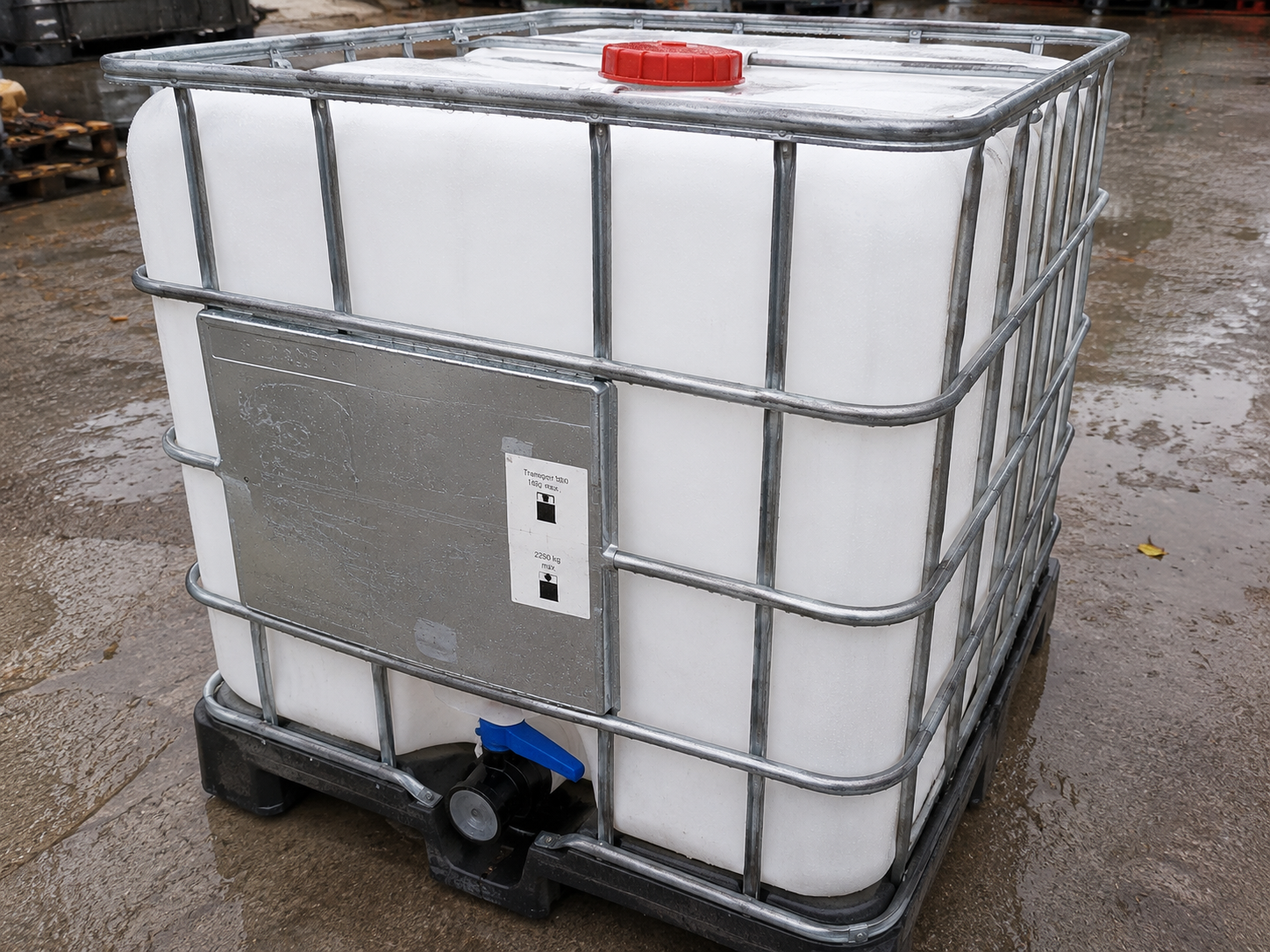
A 275-gallon IBC and a 330-gallon IBC share the same 48″×40″ pallet footprint. What changes is the bottle height. The 330 stands roughly 53 inches tall instead of 46. That gives you about 20% more product per pallet position — meaningful in warehousing, rail, and ocean container moves where you're paying for square footage rather than weight.
| Spec | Value |
|---|---|
| Nominal capacity | 330 US gallons (~1,250 L) |
| Footprint | 48″ × 40″ |
| Height | ~53″ |
| Tare weight | ~150 lbs |
| Bottle | HDPE, blow-molded |
| Cage | Galvanized tubular steel (heavier-gauge tier than 275) |
| Top opening | 6″ (standard); 9″ (select) |
| Bottom valve | 2″ ball / butterfly with cam-lock cap |
| Truckload | ~80 units per 53' dry van (height-limited in lower-deck rail) |
We stock 330-gallon units in Wash, Rebottle, and Reconditioned (UN-requalified) grades. New units are available on lead time. Food-grade 330s are stocked seasonally — ask. Full breakdown on the grading page.
On paper, switching from a 275 to a 330 gallon format gets you 20% more product per pallet position. In practice, the savings show up cleanly only when your shipping is cube-limited rather than weight-limited. For water-density products at full fill, eighty 330s exceeds the legal gross weight of a 53-foot dry van — meaning you cannot actually fit eighty full 330s on a single truck. The break-even weight at which 80 full 330s = the GVW of a typical Class 8 tractor-trailer is around 7.5 lbs per gallon (about 90% the density of water). Above that, you load fewer than eighty. Below that, the 330 saves you trips.
The takeaway: run the math for your product's actual density before assuming the 330 will reduce your freight count. For light-density products (cleaners, alcohol-water blends, many ag inputs) the savings are real and substantial. For heavier products (lubricants, concentrated chemistries) the format change does not help your truckload count and may complicate your dock's vertical handling.
Can I retrofit my 275 auto-fill station to handle 330s? Usually yes, with bracket adjustments and possibly a fill-head extension. Quotes vary; talk to the OEM of your fill station.
Do 330s require different forklift handling? Same footprint, slightly higher center of mass. Forklift drivers should travel with the load lower and corner more slowly on a 330 than a 275.
What is the empty-stack maximum for 330s? Typically 3-high for empty 330s in normal warehouse conditions; the cage rating supports this. Full stacks should remain single-tier unless you have engineered racking that supports otherwise.
A few customers a year approach us about converting an existing 275-gallon program to 330-gallon. Some succeed and save real freight cost; some try and revert. The pattern of who succeeds is consistent enough to be worth writing down.