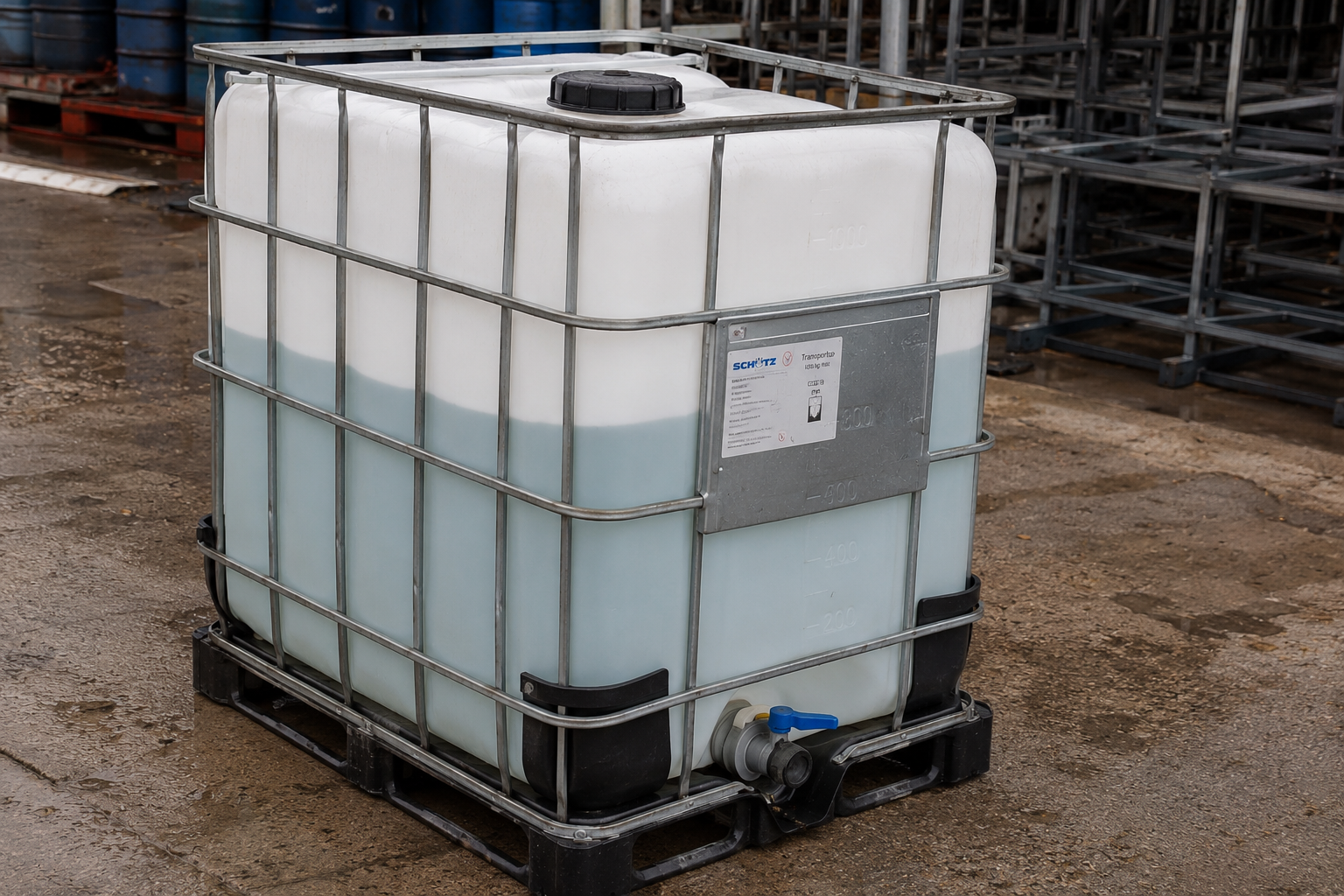
Is a reconditioned IBC actually safe for hazmat shipping?
Yes. Our Reconditioned-grade units are UN-requalified per 49 CFR § 178.801, pressure-and-leak tested, and stamped accordingly. We provide lot documentation on request. They are legally equivalent to a new IBC for permitted hazmat liquids — and most of the chemistries customers ship in them have been shipping in reconditioned units for decades.
How does the price compare to new?
Reconditioned 275 and 330 gallon IBCs typically run roughly one-third of new-unit pricing, with comparable functional performance. Rebottle grade (original cage, new bottle) typically lands in the middle. We quote per-lot because freight is a meaningful share of landed cost.
Do you have a minimum order?
No formal minimum. Single-pallet (one to four totes) orders ship LTL freight. Truckload economics start to kick in around 5–10 units. Most repeat customers eventually buy at LTL-consolidated or full-truckload rates.
What happens to a tote that can't be reconditioned?
It gets disassembled. Cage and steel pallet go to scrap (in service). HDPE bottle gets washed, granulated, friction-washed, dried, and sold as clean flake to molders making drainage tile, pallets, and automotive components. We have not landfilled an incoming tank in eight years.
Will you pick up empty IBCs nationwide?
Yes. Lower-48 coverage. Most ZIPs schedule inside 5–10 business days; major Midwest corridors usually inside a week. We pay for the empties on receipt and provide a recycling/reuse certificate for your sustainability reporting.
What contents will you accept on a buyback?
Most general industrial chemistry, agriculture inputs, food, cleaning, and personal-care residues. We cannot accept tanks that previously contained PCBs, certain pesticides, or certain pharmaceuticals. Send the SDS with your request and we will confirm in writing.
Can I get tanks with my company's branding on them?
Yes — usually as part of a closed-loop program where you produce enough volume to justify a dedicated fleet. We can label, sticker, or (for very large programs) source branded cages.
Why don't you have a phone number?
Because the questions buyers actually ask — quantity, grade, destination, timing — are easier and faster in writing. A written exchange means everyone has the spec, the price, and the delivery window on paper. We answer inquiries by email or form within one business day, every business day.
How long does delivery take?
Reconditioned stock typically ships in 3–7 business days from Dublin, Ohio. Consolidated freight reaches most U.S. ZIPs within 5 days of pickup. Tight deadlines? Call it out on the form — we can sometimes hot-shot a small lot.
Do you sell food-grade and pharma-grade tanks?
Food-grade reconditioned and new tanks: yes, stocked seasonally. Pharma-grade and infant-nutrition: new only, on lead time. We require contents documentation and we will only ship food-grade with verified prior-contents history.
Do you offer recurring orders or contracts?
Yes. For volume customers, recurring orders or a closed-loop program is usually the better economic and operational fit than transactional buys. See the Custom Programs page or note your monthly volume on the form.
What's the deal with caged metal totes?
When HDPE will not handle the chemistry — solvents, low-flash liquids, high-temp products, certain aggressive acids — stainless or carbon-steel construction is the right answer. We stock used and reconditioned metal totes and can source new on lead time.
How many times can a single IBC tote be reconditioned?
There is no fixed maximum. We see HDPE bottles complete ten or more commercial fills across multiple owners before the structural fatigue or chemistry exposure aged them out. The bottle, the cage, and the valve each have their own service life — most often the cage or valve needs attention before the bottle does. Provided each cycle includes a proper wash and requalification, the limit is the physical condition of the bottle, not an arbitrary cycle count.
How do you wash a tank without compromising its rating?
Our wash protocols are calibrated to remove residual chemistry while staying well below the HDPE distress threshold. Caustic concentration, temperature, and dwell are all metered. We have run controlled comparative tests on bottle wall thickness before and after wash cycles — the polymer change is well below measurement tolerance.
Can I tour the Dublin facility?
Yes, by appointment, especially for customers considering closed-loop programs. Tours typically last 90 minutes and include the intake area, wash bay, requalification testing, the grade-card production process, and the grind line. Email the request through the form on this site.
What is your facility carbon footprint, and how do you offset it?
Our facility energy use (electricity from the PJM grid plus natural gas for wash water heat) accounts for roughly 8 kg CO₂e per tank reconditioned. We do not currently buy offsets — our position is that the avoided new-tank production from each reconditioned unit far outweighs the operational footprint, and offsets risk the appearance of greenwashing. We are evaluating on-site solar for a 2026 or 2027 install.
Do you have a corporate policy on which chemistries you will not handle?
Yes. We will not knowingly accept tanks with prior contents of PCBs, certain restricted-use pesticides, or certain pharmaceuticals on our reject list. We also will not accept tanks where prior contents are undocumented and the buyer cannot establish the chain. If we cannot identify what was in the tank, we cannot put a reconditioned grade card on it.
What payment terms do you offer?
Net 30 from invoice date for established accounts. New accounts pay against a proforma invoice prior to shipment. Larger recurring programs sometimes negotiate longer terms or staged payments. We accept ACH, wire, check, and credit card (small processing fee).
What insurance coverage do you maintain?
Standard commercial general liability, product liability, professional liability, and workers compensation insurance. Carrier insurance covers tanks in transit. Documentation available to customer purchasing and risk-management teams on request.
Do you have references I can talk to?
Yes. After an initial scoping conversation we can connect you with one or two customer references in your industry. Most customers prefer to keep their reconditioning relationships quiet for procurement-strategy reasons, so we ask before sharing — but most are willing to take a 15-minute call.
What happens during an incident or quality complaint?
Incident protocol: email us within 5 business days with photos and a description. We respond within 1 business day, pull the lot record, and propose a resolution path. Outcomes are typically replacement, credit, or refund depending on the situation. We document every incident internally to feed back into our quality system.
Are your wash and grind operations EPA-permitted?
Yes. Our Dublin facility operates under Ohio EPA permits for industrial process water discharge and air emissions related to the grind operation. Annual reporting is filed and is available to interested parties.
Can you help us update our company's procurement specs?
Yes — we have helped a number of customers move from "new only" spec language to functional-equivalence language that allows reconditioned units while preserving quality and compliance protections. We can share template language and walk through the internal change-management process.
How do I file a sustainability report using your data?
Closed-loop program customers receive monthly aggregated reporting suitable for direct inclusion in EPA WARM-based sustainability disclosures. One-time buyers can request per-shipment diversion certificates. For more complex reporting frameworks (CDP, GRI, TCFD), we can produce custom reporting against your specific methodology.
What is your average customer relationship length?
Our top 25 customers by volume have been with us for an average of 6.8 years. We do not actively prospect — most new customers come through referrals from existing ones. The reconditioning industry runs on long relationships because trust takes years to build.
Do you handle hazmat shipping yourself?
No — hazmat shipments route through DOT-authorized carriers on dedicated hazmat lanes. Our drivers and tractors are not hazmat-certified for direct service, but our carrier partners are, and the documentation flows through us. The result is the same to the customer: one BOL, one tracking number, fully compliant.
Will reconditioned tanks be accepted by my insurance carrier?
Almost always yes. UN-requalified reconditioned IBCs are legally equivalent to new units for hazmat shipping, and insurance carriers treat them the same way. If your specific policy has restrictions, ask us — we can provide documentation that addresses the underwriter's concerns.
Do you ship empty tanks back to me after closed-loop reconditioning?
Yes — that is the whole point of the closed-loop model. Tanks are reconditioned, requalified, and returned to your specified destination(s) on your specified cadence.
How do I verify that a tank actually went through reconditioning, vs. just being washed?
Check the grade card on the cage. Reconditioned-grade units carry a date stamp for the most recent requalification cycle, and lot documentation is available to confirm the specific testing performed. If you are unsure, ask us to send the lot record.