01
Home
A standalone page — no sub-sections.
Most tanks should be reused, not recycled. But when a bottle has finally aged out — or the contents made requalification unwise — we make sure the HDPE goes back into industry instead of into a landfill.
Tell us what you need or what you have. We respond within one business day, every business day.
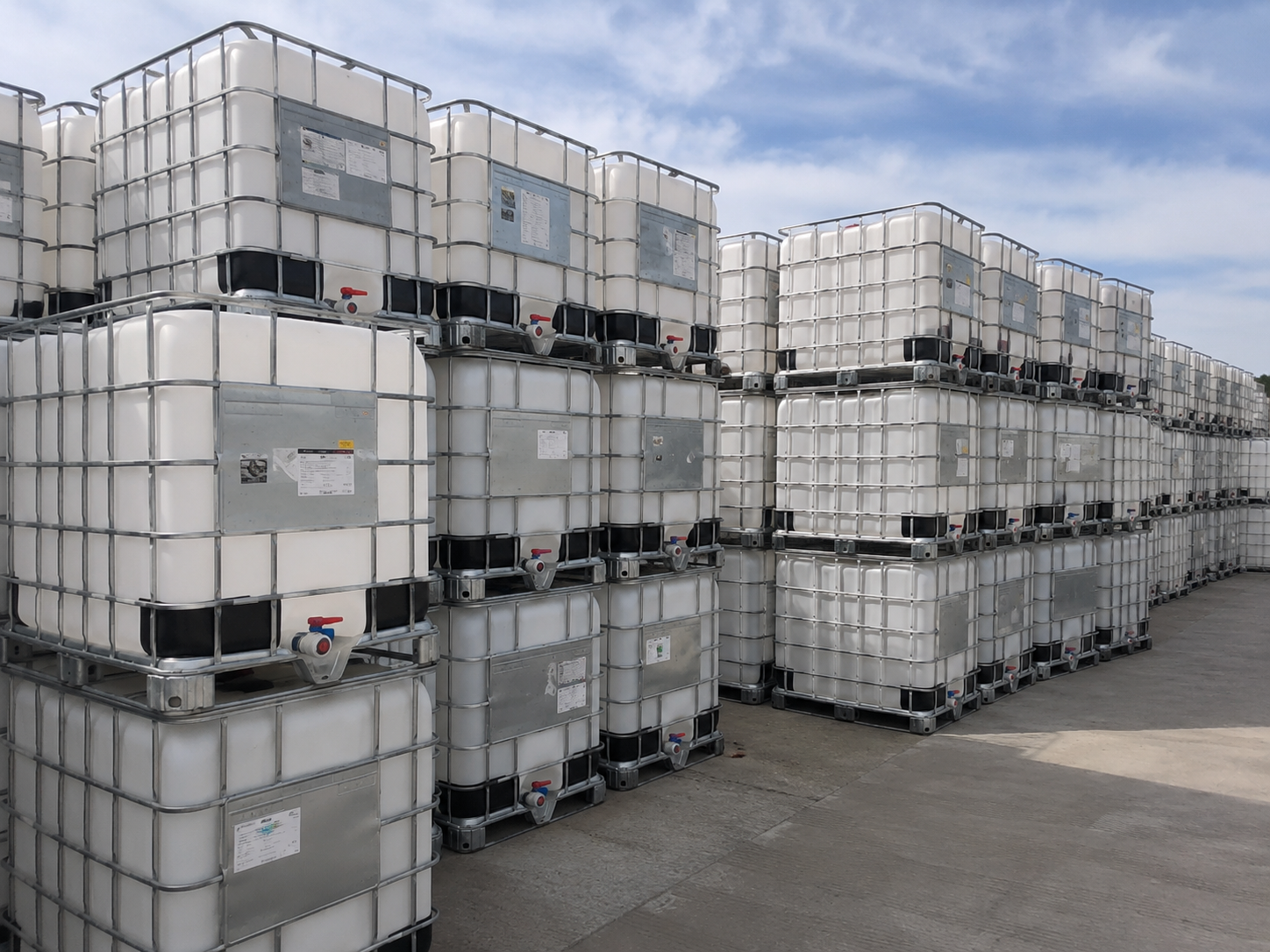
A tank that can't be requalified still represents roughly 130 lbs of clean HDPE — a high-value, infinitely-recyclable polymer. Landfilling it would be a small environmental crime and a real economic one. Our recovered flake routinely tests at melt-flow consistencies comparable to virgin grade.
Read about our audited zero-landfill methodology or talk to us about a closed-loop program.
Our reclaimed HDPE flake gets sold to a short list of regional molders for applications where polymer-grade tolerance is high and post-consumer recycled content is valued:
We deliberately do not sell our reclaimed flake into food-contact or potable-water applications. The provenance chain on a reclaimed tote — multiple owners, multiple industrial fills — cannot match the controlled supply chain those applications require. The flake we produce is industrial-grade for industrial uses.
Reclaimed HDPE flake currently trades at a meaningful discount to virgin grade — the spread varies with petroleum prices and recycled-content demand. For us, recycling revenue covers most of the cost of running the grind line; the financial argument for end-of-life recovery is approximately break-even. The environmental argument is what actually drives the investment.
Before 2021, end-of-life tanks went to scrap dealers for HDPE recovery — meaning the polymer ended up downstream of a sorting and washing process we did not control. Building our own grind line let us close the loop: we know exactly what enters the grinder, how it was washed, and where it goes after. The capital investment was significant, but the operational and environmental control was worth it.
What share of incoming tanks actually goes to recycling vs. reuse? Roughly 6%. The other 94% gets reconditioned and re-circulated.
Do you charge for end-of-life recycling pickup? Not for tanks that come in with documented prior contents — we cover the freight against the polymer value. For tanks with unknown contents or higher disposal complexity, we may charge a nominal fee.
Can you certify zero landfill for our sustainability reporting? Yes. We provide certification of zero landfill for any tanks we receive from your operation. Audited every other year.
What happens to the steel cages? Sold to local scrap dealers under a tracked chain-of-custody program; the steel re-enters the regional scrap stream.
What happens to hardwood pallets? Shredded for landscaping mulch supply or used as boiler fuel by a regional partner. None to landfill.
Recycling and reuse are often conflated in industrial sustainability conversations. They are not the same thing, and the order matters environmentally.
Reuse keeps the polymer in its highest-value form — an intact, functional container that displaces a new-container manufacture downstream. The carbon impact of one reuse cycle is roughly 294 kg CO₂e avoided per 275-gallon tank.
Recycling reduces the polymer to flake, which then needs to be re-extruded into a new (lower-value) product downstream. The carbon impact of one recycling cycle is roughly 150 kg CO₂e avoided per equivalent polymer mass — meaningful but roughly half of what reuse delivers.
For every tank, we run reuse first. Recycling is the disposition we route to when reuse is genuinely impossible. The industry vocabulary often treats these interchangeably; the math does not.