01
Home
A standalone page — no sub-sections.
Used isn't a downgrade. Used is a tank that has already proven it can take a beating, that's now been hot-washed, leak-tested, and re-certified for hazmat duty per 49 CFR.
Tell us what you need or what you have. We respond within one business day, every business day.
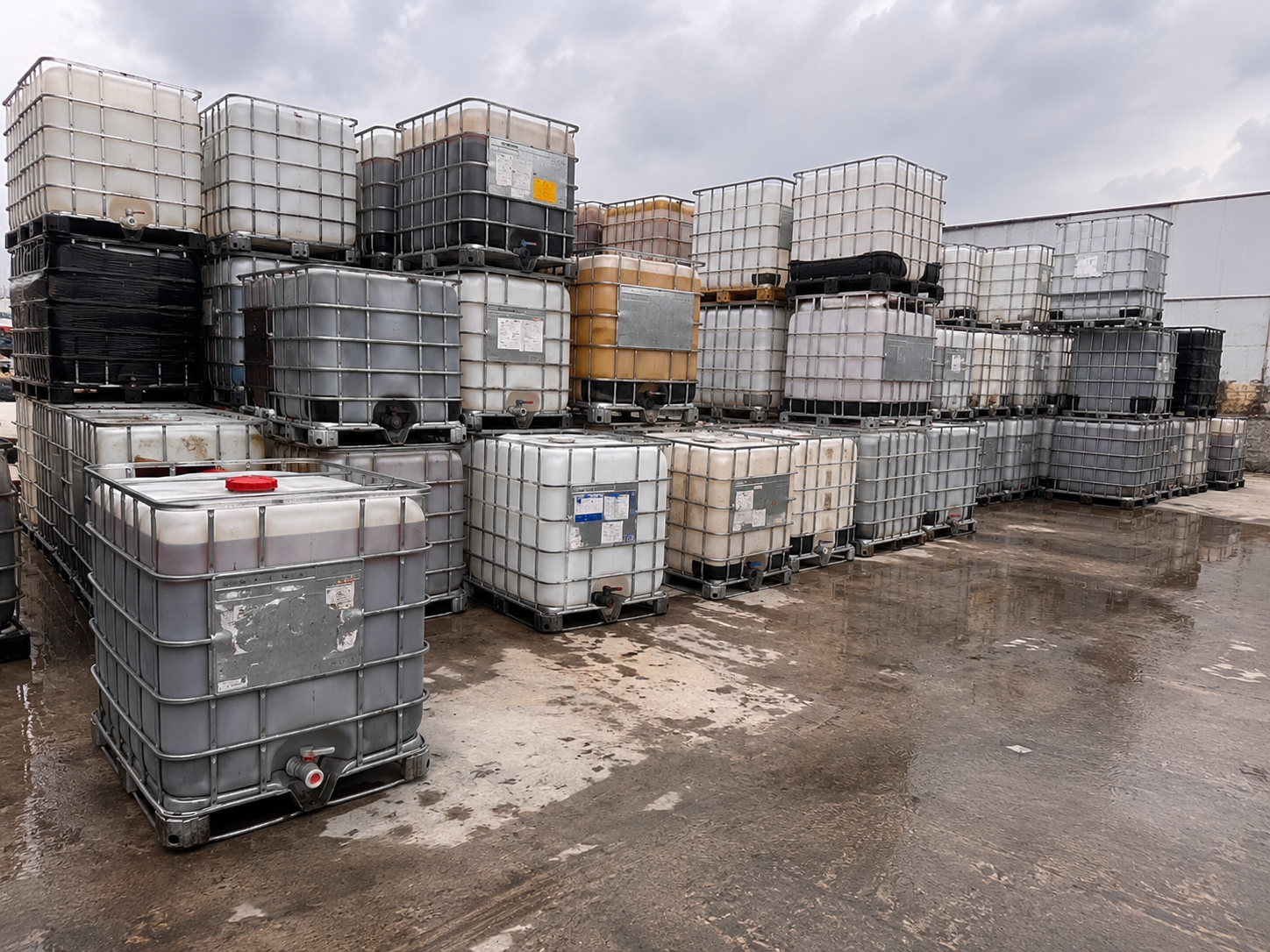
A reconditioned IBC at IBC Recycle USA has been through every step below, in order, before it leaves the dock. Anything that doesn't pass a step gets routed to a lower grade — or, if the bottle is unsalvageable, to our grind line for HDPE flake recovery.
Reconditioned units leaving our facility under the "Reconditioned" grade are UN-requalified per 49 CFR § 178.801, with documentation available on request. See our plain-English 49 CFR overview for what that actually means for your shipping paperwork.
Across the chemistries we service, a reconditioned 275 or 330 gallon IBC matches the functional performance of a new one and saves roughly two-thirds of the per-unit cost and roughly 90% of the embodied carbon. It is the right answer most of the time. The customers who insist on new are usually subject to spec language written before the reconditioning industry had matured — language that, increasingly, is being revised.
For a buyer running 200 reconditioned totes a month versus 200 new ones, the per-month savings land around $27,000. Annualized, that is $324,000 of working capital that no longer lives in your packaging inventory. For a buyer running 1,000 a month, the numbers obviously scale; closed-loop programs at that volume typically deliver 30–45% total cost reduction against an all-new baseline, including the round-trip freight and reconditioning fee.
Where buyers sometimes get the economics wrong is by comparing the per-unit price of a reconditioned tote against the per-unit price of a new tote without including the carbon avoided, the inventory turn improvement, or the simplified end-of-life accounting. The honest picture is that reconditioned is meaningfully cheaper and structurally simpler to manage across the lifecycle.
Each reconditioned tank that goes back into commercial service displaces a tank that would otherwise need to be molded new. The embodied carbon difference is roughly 294 kg CO₂e per cycle (318 kg new baseline minus 24 kg reconditioning footprint). Across a closed-loop program of 1,000 tanks cycling every 90 days, that is more than 1,000 metric tons of CO₂e avoided per year — a sustainability headline that most procurement teams underestimate by a factor of three.
We provide diversion certificates for every shipment on request. Customers running closed-loop programs receive monthly aggregate diversion reporting that can drop directly into their corporate sustainability disclosures.
UN-requalified reconditioned units are legally equivalent to new units for hazmat shipping under 49 CFR. The lot documentation we provide includes the requalification date, the pressure-test record, the prior-contents declaration, and the wash protocol — exceeding what most regulators ask to see during inspection.
The regulatory case for reconditioned over new in hazmat applications is therefore neutral: both are eligible, both require the same paperwork on the shipping side, both behave the same in transit. The economic and environmental cases are what move the needle.
How can I tell on visual inspection whether a tank has been requalified? The cage stamp is updated with the requalification date — look for a date stamp within 2.5 years of your fill date for hazmat-eligible service. The grade card on the cage will also call out the requalification date and lot reference.
What happens if a reconditioned tank fails in service? Same incident protocol as a new tank failure: insurance claim, root-cause analysis, replacement. We support customers through this process with full lot history including prior fills, wash records, and pressure-test data.
How long does reconditioning take? The wash and requalification cycle itself runs three to seven business days per batch through our facility. Total turnaround from intake to ready-to-ship is usually under two weeks.
What is the maximum number of times a tank can be reconditioned? No fixed maximum. The practical limit is when the bottle begins to show structural fatigue (stress cracks, dimensional drift). For most chemistries that takes ten or more cycles across multiple owners, depending on prior contents and storage conditions.
Can I send my own tanks back for reconditioning? Yes — that is one of the most common ways customers use our service. See the reconditioning service page for the workflow.
Every reconditioned IBC that leaves our dock arrives with a specific set of documents and physical items. For procurement teams writing acceptance specs, here is the complete deliverable list.