01
Home
A standalone page — no sub-sections.
There is a narrow band of applications where virgin polymer is genuinely required. We stock new IBCs for those — and we'll tell you when your job isn't one of them.
Tell us what you need or what you have. We respond within one business day, every business day.
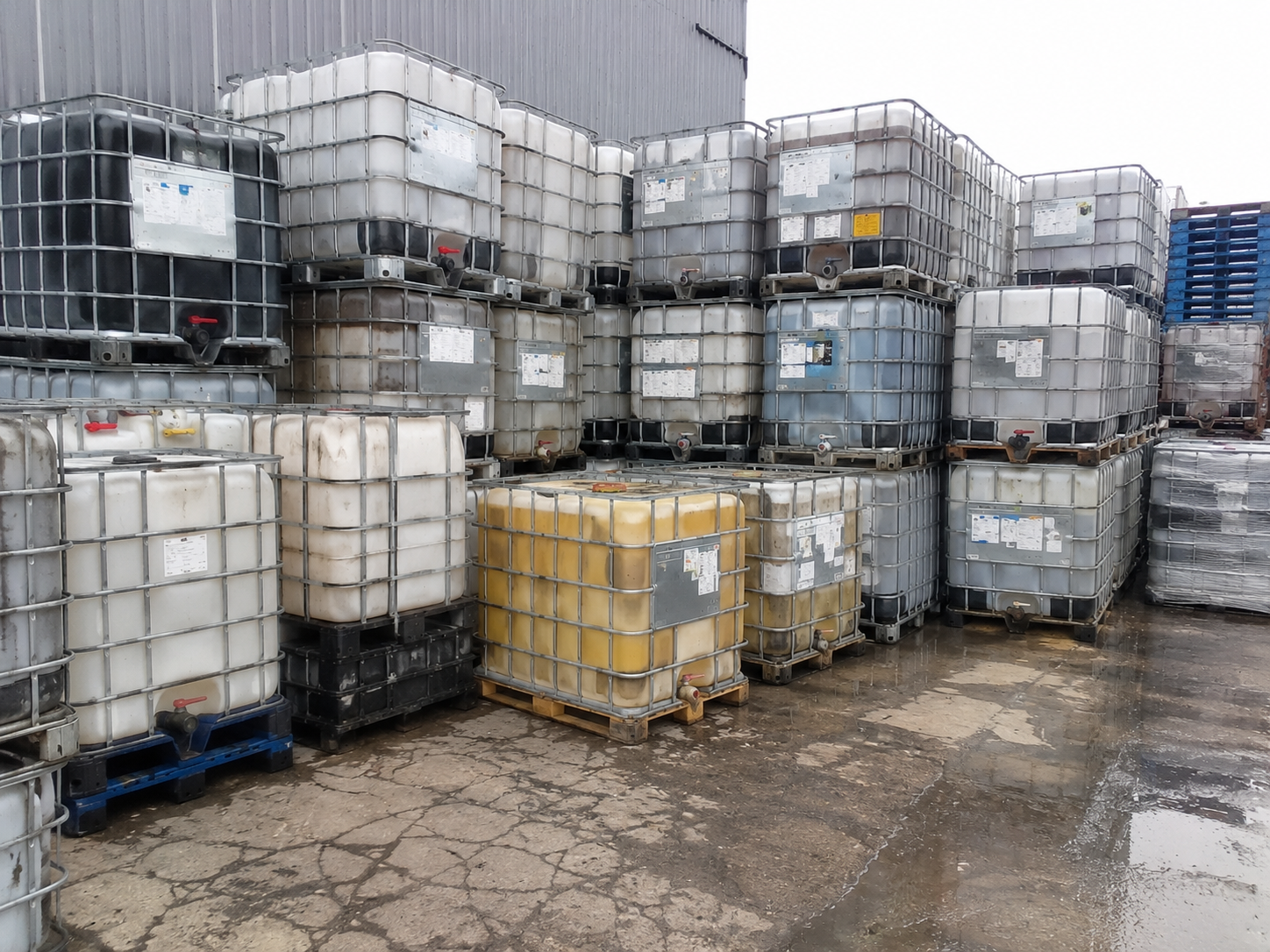
Most industrial chemistries, agriculture inputs, cleaning concentrates, and many syrups and oils run perfectly in a reconditioned tank — at roughly a third of the cost and a fraction of the embodied carbon. If you've always specified new because you've always specified new, that's worth a fresh look.
Stock new units typically ship in 3–5 business days. Special-resin or customized configurations run 3–6 weeks. Request a quote and we'll confirm.
We are a reconditioning company, and we will be the first to suggest reconditioned where it fits. But there are real applications where new is the right answer, and when you need new, working with us has three advantages.
What virgin resin do your new bottles use? Mainstream HDPE blow-mold grade with FDA 21 CFR 177.1520-compliant resin available on request. We can source UV-stabilized resin for outdoor applications and high-MFI grades for thin-wall designs.
Do new IBCs ship with the manufacturer's certification? Yes. Every new tank carries the manufacturer's UN markings and certification number, and we provide a full COA/COC package for regulated applications.
Can I order new IBCs with custom labeling or branding? Yes, at sufficient quantity. Sticker labeling on most quantities; in-mold labeling and branded cages on programs above 200 units.
What is the carbon argument against new IBCs? A new 275-gallon IBC has roughly 318 kg CO₂e embodied. A reconditioned unit displacing it carries roughly 24 kg CO₂e net per cycle. For applications where reconditioned will not work, new is the right answer; for the rest, the carbon argument against new is hard to refute.
Counterintuitively, there are scenarios where new is the cheaper landed-cost option, not just the more conservative one.
Customers occasionally ask us about the upstream environmental footprint of virgin HDPE itself — where the polymer comes from, what the carbon math looks like, what the recyclability profile is. Quick answers.
Where does virgin HDPE come from? Natural gas feedstock through ethylene production, polymerized into HDPE pellet at integrated petrochemical facilities. North American production runs mostly on Gulf Coast and Alberta natural gas.
How much CO₂e per kilogram of virgin HDPE pellet? Roughly 2.0 kg CO₂e per kilogram of pellet, per major peer-reviewed life-cycle assessments. Lower than most other commodity plastics.
Is HDPE recyclable? Yes, technically and at industrial scale. The reality is that most HDPE that gets recycled is post-industrial, not post-consumer; only a small share of consumer HDPE actually ends up in recycle streams.
Why does that matter for IBC totes? Because IBC bottles are post-industrial HDPE in its cleanest form: a known polymer, a known additive package, a recovered material with minimal contamination. When we grind end-of-life bottles for flake, the material that comes out is competitive with virgin grade.