01
Home
A standalone page — no sub-sections.
Two ways to use this service: buy tanks we've already reconditioned, or send us your own fleet for processing on a return-trip basis.
Tell us what you need or what you have. We respond within one business day, every business day.
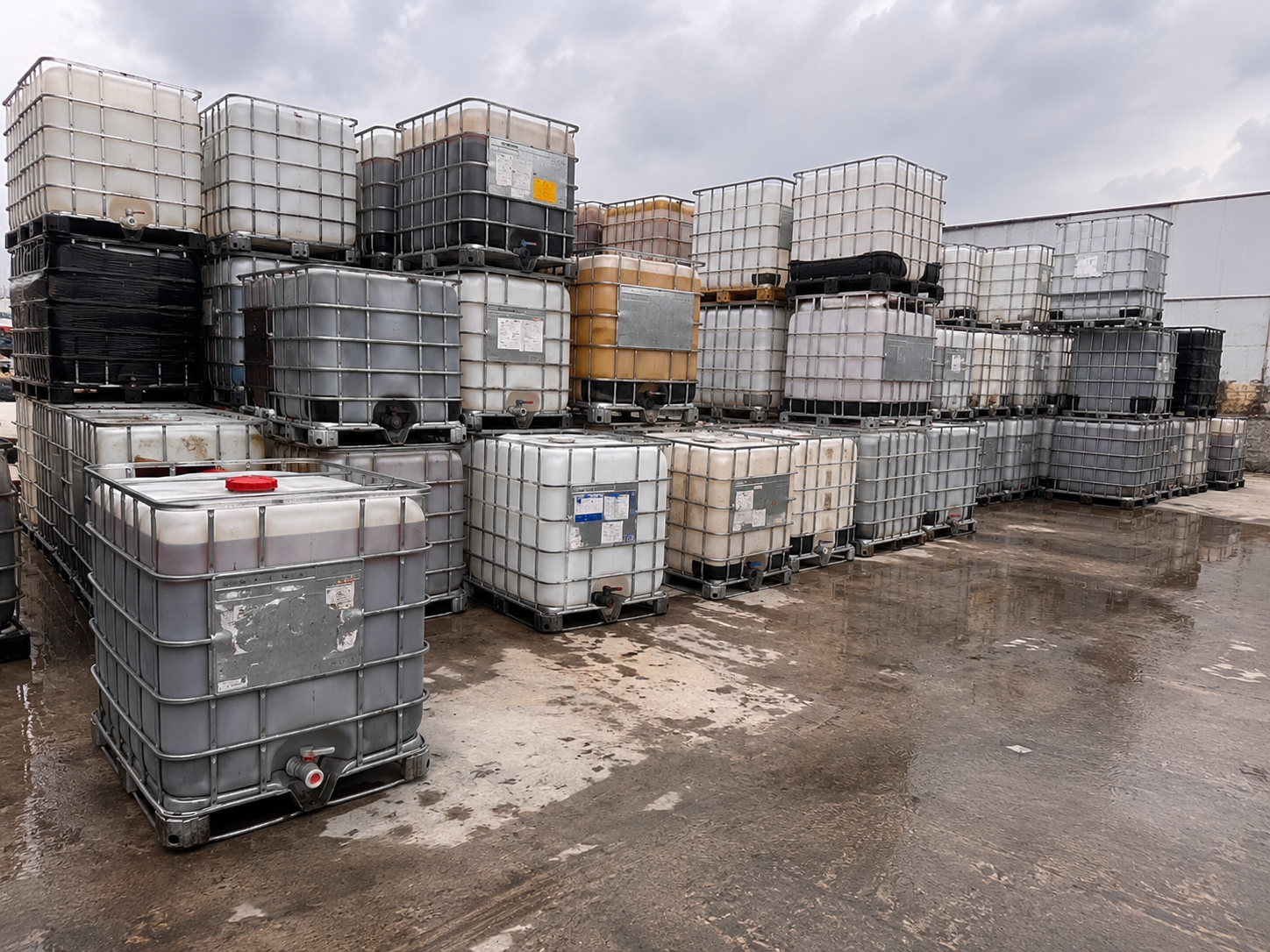
Our reconditioned 275 and 330 gallon inventory ships in 3–7 business days. Every unit carries a grade card and (for UN-requalified grades) full lot documentation per 49 CFR § 178.801. See the product page for the full grade table.
High-volume generators often run their own fleet of branded tanks. We will receive, recondition, requalify, and return your units on a scheduled basis. Typical cycle:
Per-tank reconditioning pricing depends on contents, volume, and round-trip freight. Most return-to-service customers see total landed cost (recondition + freight both ways) at roughly 40% of new-unit replacement — with the carbon footprint at roughly 15% of replacement. We'll quote based on your fleet profile.
A wash recipe is not one-size-fits-all. Different residual chemistries require different temperatures, dwell times, and chemistry concentrations. Our four standard recipes:
Tanks routed to the food-grade reconditioning line get an additional rinse cycle and food-grade gasket replacement, with post-wash swab verification.
For UN-requalified output, every tank goes through a pressure-test sequence that satisfies the requirements of 49 CFR § 178.801. The full protocol:
For customers running their own branded or unbranded fleets through us on a contract-recondition basis, the typical program structure looks like this:
What is the difference between "reconditioning" and "refurbishing"? Reconditioning carries a specific regulatory weight — UN requalification, pressure testing, lot documentation. "Refurbishing" is industry vernacular that may or may not include those things, depending on the operator.
What is your throughput capacity? Roughly 5,000 tanks per month at current capacity. We can scale further with notice.
Can I send a single tank for reconditioning? Yes, but the economics rarely make sense below 10–20 tank batches due to freight.
What happens if a tank fails reconditioning? It gets downgraded to the highest grade it can support (e.g., Reconditioned → Wash, or Wash → Bottle Tight), or routed to end-of-life if the bottle is unrecoverable. Customer receives a per-tank disposition report.
Do you recondition tanks from other manufacturers? Yes — we recondition virtually every major manufacturer's 275 and 330 gallon HDPE bottle, with parts compatibility for legacy and current designs.
For a customer running 1,000 tanks per month through their own production line, the economic comparison between buying new every time and running their own fleet through us looks like this:
Buy-new scenario: 1,000 tanks × $230/tank × 12 months = $2.76M annual packaging spend. No empty pickup; tanks scrapped at downstream points; no recovery of value or carbon.
Closed-loop reconditioning scenario: pool of 2,800 tanks built over 6 months; ongoing reconditioning at $45/tank × 1,000/month × 12 = $540K annual reconditioning spend. Plus inbound and outbound freight (consolidated): ~$200K annual. Plus initial pool investment, amortized: ~$300K annual over 5 years.
Net annual cost in the reconditioning scenario: roughly $1.04M, against $2.76M in the buy-new scenario. Savings: ~$1.7M annually. Carbon impact: roughly 290 metric tons CO₂e avoided per year against the buy-new baseline.