01
Home
A standalone page — no sub-sections.
Industrial buyers don't have time to chase spec sheets. This page collects everything you'd otherwise have to ask three vendors for.
Tell us what you need or what you have. We respond within one business day, every business day.
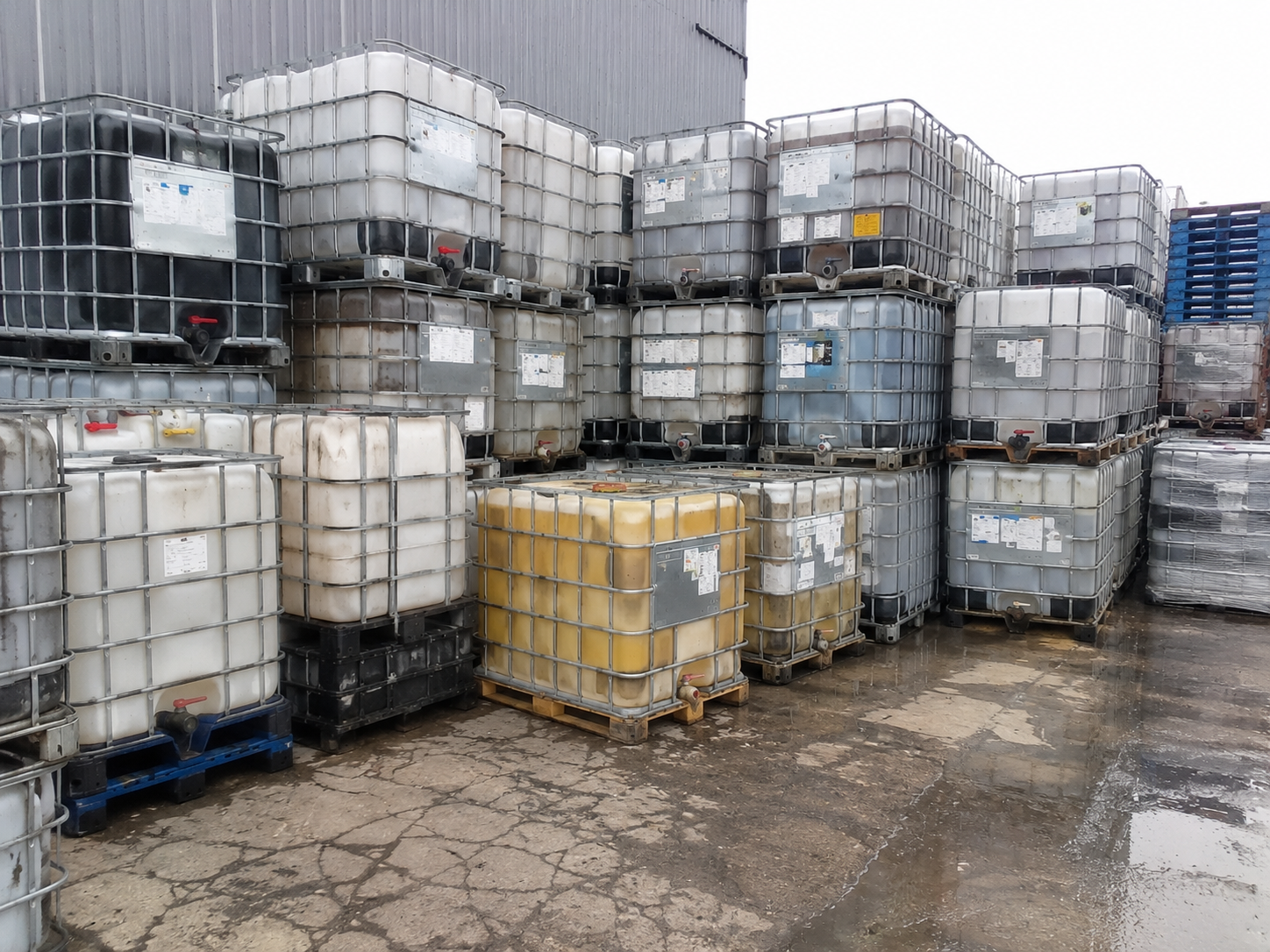
| Spec | 275 gal IBC | 330 gal IBC | Caged metal 275 |
|---|---|---|---|
| Nominal capacity | 275 US gal / 1,041 L | 330 US gal / 1,250 L | 275 US gal |
| Footprint (L×W) | 48″ × 40″ | 48″ × 40″ | 48″ × 40″ |
| Height | ~46″ | ~53″ | ~46″ |
| Tare weight | ~135 lbs | ~150 lbs | ~250–600 lbs |
| Gross weight (water) | ~2,430 lbs | ~2,900 lbs | ~2,550 lbs |
| Top opening | 6″ (or 9″) | 6″ (or 9″) | variable |
| Bottom valve | 2″ ball / butterfly | 2″ ball / butterfly | 2″ or 3″ |
| Per 53' van | ~80 units | ~80 units (height-limited in rail) | ~80 units |
| Per 40' ocean container | ~60 units | ~60 units | ~60 units |
| Stack rating (full) | typically 2-high | typically 1-high (confirm) | 3-high (most) |
| From | To | Multiplier |
|---|---|---|
| US gallons | Liters | × 3.785 |
| US gallons | Cubic feet | × 0.1337 |
| 275 gallons of water | Pounds | ~2,295 |
| 330 gallons of water | Pounds | ~2,754 |
| 1 IBC (avg) | 55-gal drums equivalent | 275 ≈ 5 drums; 330 ≈ 6 drums |
A standard 53' dry van fits 20 GMA pallets on the floor, double-stacked to 40, with room for 80 IBCs at typical 46″ or 53″ height. A 40' high-cube ocean container fits 20 floor pallets, with double-stack possible for 275s (40 units). A 20' container fits 10 floor pallets (20 units double-stacked, where height allows).
Reconditioned IBCs intended for regulated hazmat duty must be UN-requalified per 49 CFR § 178.801 and stamped accordingly. See our plain-English 49 CFR overview for what those markings mean and when you actually need them.
| Dimension | 275 gal | 330 gal | Caged metal 275 |
|---|---|---|---|
| Length | 48″ | 48″ | 48″ |
| Width | 40″ | 40″ | 40″ |
| Total height (with pallet) | 46″ | 53″ | 46″ |
| Bottle-only height | ~40″ | ~47″ | ~40″ |
| Pallet thickness | ~6″ | ~6″ | ~6″ |
| Top opening diameter (standard) | 6″ | 6″ | varies |
| Top opening (large) | 9″ | 9″ | varies |
| Bottom valve thread | S60×6 buttress | S60×6 buttress | NPT or BSP |
| Bottom valve size (default) | 2″ | 2″ | 2″ or 3″ |
| Empty weight | ~135 lbs | ~150 lbs | 250–600 lbs (material-dep) |
| Full weight (water) | ~2,430 lbs | ~2,900 lbs | ~2,550 lbs |
| Full weight (8 lb/gal product) | ~2,335 lbs | ~2,790 lbs | ~2,450 lbs |
| Stack rating (cage spec) | ~5,000 lbs | ~3,500 lbs | 5,000–8,000 lbs |
| Pallet jack compatible | Yes (4-way fork) | Yes (4-way fork) | Yes |
| Container type | 275 capacity | 330 capacity | Notes |
|---|---|---|---|
| 53' dry van | 80 units | 80 units | Weight-limited for dense products |
| 48' dry van | 72 units | 72 units | Older trailer standard |
| 53' flatbed | 40 units (single tier) | 40 units | Tarping required |
| 40' high-cube ocean | 60 units | 60 units | Standard ocean export |
| 40' standard ocean | 40 units (single tier) | 40 units | Limited stack height |
| 20' ocean | 20 units | 20 units | Less common for IBC freight |
| Rail boxcar (large) | 96 units | 96 units | Domestic intermodal |
| Storage type | Min clearance (275, 2-high) | Min clearance (330, 1-high) |
|---|---|---|
| Floor stacking, full tanks | 96″ (8') | 60″ (5') |
| Pallet rack opening (full) | 50″ per opening | 57″ per opening |
| Drive-in rack (full) | 52″ per opening | 58″ per opening |
| Outdoor stacking, empty | 180″ (15' for 3-high) | 180″ |
| Aisle width for forklift (loaded) | 96″ minimum | 96″ minimum |
Top opening diameter affects which fitting standards are compatible with your fill line. The two standards in U.S. industry are 6-inch (most common) and 9-inch (Schütz-style and certain legacy bottles).
| Top opening size | Common standards | When you need it |
|---|---|---|
| 6″ | NW1 buttress; standard cap and gasket | Default for virtually all U.S. fillers |
| 9″ | NW2 (Schütz); custom larger fitting | High-flow gravity-fill operations |
| Pallet type | Wt | Fork access | Best for |
|---|---|---|---|
| Composite (plastic) | 20–30 lbs | 4-way | Indoor warehousing, repeated cycle |
| Hardwood | 40–55 lbs | 2-way or 4-way | Cheapest; ag/single-use; rotting risk if outdoor |
| Steel | 60–80 lbs | 4-way | Heavy-duty; outdoor; long service |
| HDPE (full plastic) | 20–30 lbs | 4-way | Food and clean-environment applications |
For operations integrating IBCs with existing auto-fill or gravity-fill stations, here are the practical fill-line clearance numbers to confirm before changing format.
Will a 330 fit through a standard 8-foot warehouse door? Yes — 53 inches plus the forklift, well under 8 feet (96″). But factor in the operator standing on the forklift, and verify clearance.
Can I fill a 275 with less than 275 gallons safely? Yes. Partial fills are operationally fine; check liquid-product handling regulations if your chemistry classifies as hazmat for transit (some classes have minimum-fill rules).
What is the maximum operating temperature for HDPE? Continuous: 140°F. Brief excursion: up to 180°F. Above 180°F you want stainless or carbon-steel construction.
What is the minimum operating temperature? HDPE remains structurally sound to about -20°F, but freezing of contents is usually the limiting factor before the polymer.
Can I customize my IBC dimensions? No — IBCs are standardized to the 48×40 GMA footprint for compatibility with the global supply chain. Custom-dimension containers exist but fall outside the IBC category.
Three sizing mistakes that come up regularly in customer conversations, and how to avoid them.
The 80-unit-per-trailer number is a geometry maximum, not a universal load. For dense products, you will hit the 80,000 lb gross vehicle weight limit at far fewer tanks. Always calculate gross weight (product + tank + pallet) × unit count and verify you are not over GVW before committing to a per-truck unit count.
The 330 is 7 inches taller than the 275. Most receiving docks, fillers, and warehouses handle the change without issue, but some racks, doorways, and overhead conveyors do not. Audit every touchpoint before commiting to the format change.
The 9-inch opening exists for high-flow gravity-fill operations. For 95% of buyers, the standard 6-inch opening is the right call — it has broader fitting compatibility, better gasket selection, and a slightly lower per-tank cost. Specifying 9-inch as a "just in case" can limit your tank pool and complicate fill-line compatibility.