01
Home
A standalone page — no sub-sections.
Everything we stock fits one of six categories. Most of our shipments are reconditioned 275 and 330 gallon totes, but we keep new units and accessories for the jobs that actually need them.
Tell us what you need or what you have. We respond within one business day, every business day.
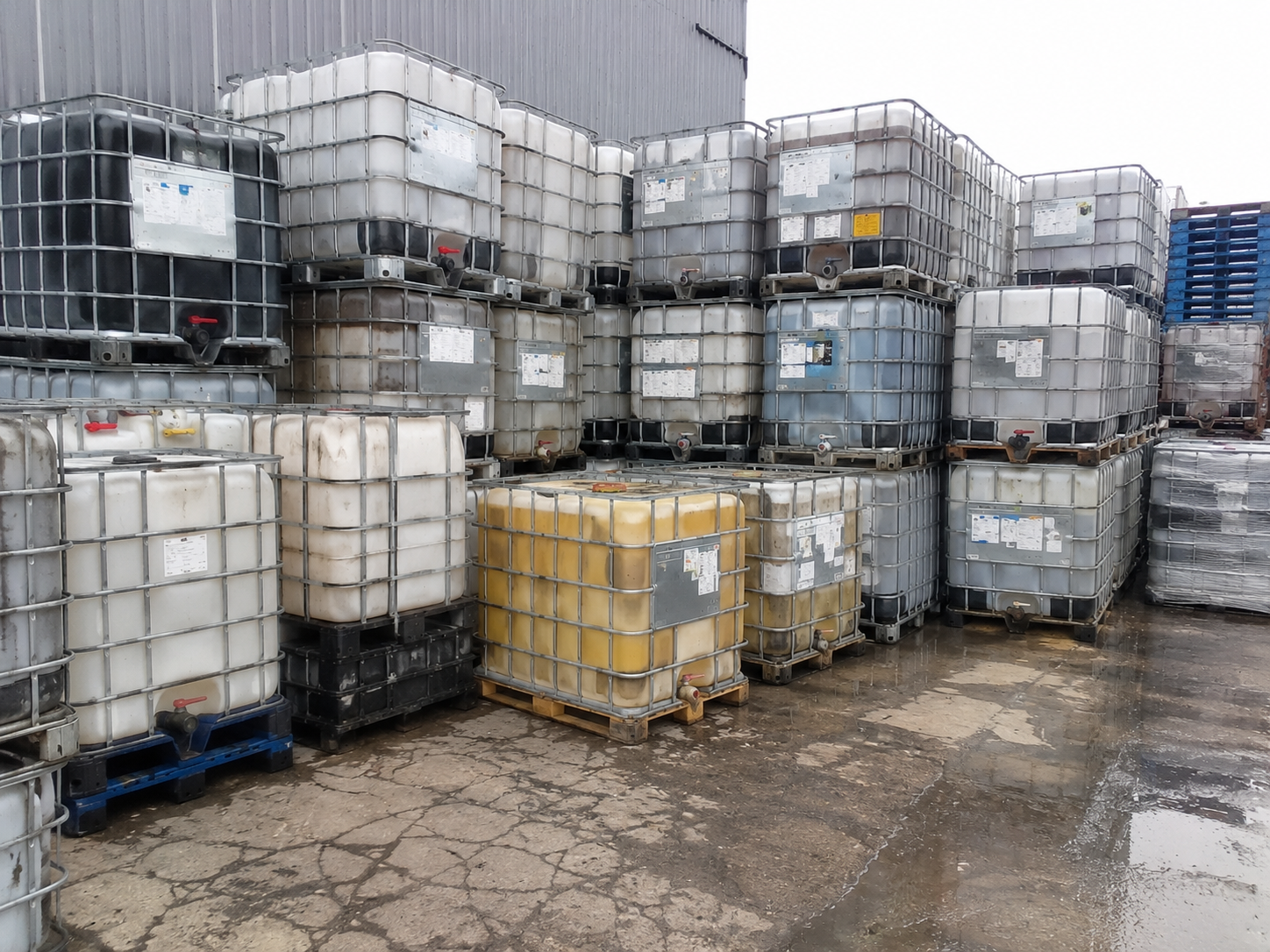
The workhorse footprint. 48×40 pallet, 46″ tall. Fits in a standard 53' trailer at 80 units.
Same pallet footprint, more volume. 53″ tall. Common where vertical clearance allows.
Virgin polymer, for the specs that demand it: certain food, pharma, and aggressive chemistry.
Washed, requalified, recertified. Our flagship product and the right call for most jobs.
Stainless and carbon-steel caged totes for the chemistries HDPE can't handle.
Replacement valves, gaskets, lids, foot pads, fitting kits, secondary containment.
Most buyers know they want an IBC. The honest question is which one. As a rule of thumb:
When in doubt, send us the SDS — we'll recommend a format, a grade, and a price. See the size guide for full dimensions and the grading system for the difference between Bottle, Wash, Rebottle, and Recon.
| Category | Typical price (FOB) | Lead time | Hazmat eligible | Best for |
|---|---|---|---|---|
| 275 gal reconditioned | $70 – $110 | 3–7 business days | Yes (UN-requalified) | General industrial chemistry, ag inputs, cleaning concentrates |
| 330 gal reconditioned | $95 – $135 | 3–7 business days | Yes (UN-requalified) | High-volume product where pallet position is the binding constraint |
| 275 / 330 gal new | $200 – $280 | 3–5 business days from stock; 3–6 weeks special | Yes | Pharma, infant nutrition, certain chemistry that bars reuse |
| Rebottle (new bottle, original cage) | $140 – $180 | 5–10 business days | Yes | Like-new interior at substantially below new-unit pricing |
| Caged metal tote (stainless / carbon) | $650 – $2,400+ depending on grade | 10–30 business days | Yes | Solvents, low-flash chemistry, high-temp products |
| Parts / accessories | $3 – $250 | 2–5 business days | N/A | Replacement valves, gaskets, lids, foot pads, secondary containment |
Most buyers come to us already knowing they want an IBC but uncertain which sub-format and which grade is the right call. Run through these five questions in order and you will land on the right product in under a minute.
Cross-reference the SDS against published HDPE compatibility tables. For roughly 95% of industrial chemistry the answer is yes. If no, you want a caged metal tote — see caged metal totes.
If your customer's purchase order specifies new IBCs and your account team is not ready to update the spec, you want a new IBC. If the spec is silent or specifies UN31HA1/Y without restricting reused, reconditioned is the better economic and environmental answer.
For pharma and infant nutrition, default to new. For most food and beverage intermediates, food-grade reconditioned tanks are well-accepted and a fraction of the cost — but you should request documentation of prior contents and wash protocol.
If vertical clearance is tight (under 8 feet to ceiling or rack opening), stay with the 275 gallon format. If pallet position is the binding constraint and clearance is adequate, the 330 gallon gives you 20% more product per pallet.
If your monthly throughput is above 200 totes a month and there is reverse-logistics potential (your downstream customers return empties to known points), a closed-loop program almost always beats transactional purchasing on both cost and carbon. Below that threshold, transactional orders against quoted spec are the right approach.
Regardless of grade or format, every IBC that leaves our Dublin yard ships with the following as standard:
We do not publish per-unit prices on this page because IBC pricing has three moving parts: spot polymer resin index, lot grade quality at intake, and freight cost to your specific ZIP. A quoted price that holds today often does not hold next quarter, and a tile of prices on a website misleads more often than it informs. Instead, here is the framework that drives every quote we give.