01
Home
A standalone page — no sub-sections.
We didn't start out to be a sustainability company. We started out trying to stop watching usable tanks get smashed for $7 of scrap value.
Tell us what you need or what you have. We respond within one business day, every business day.
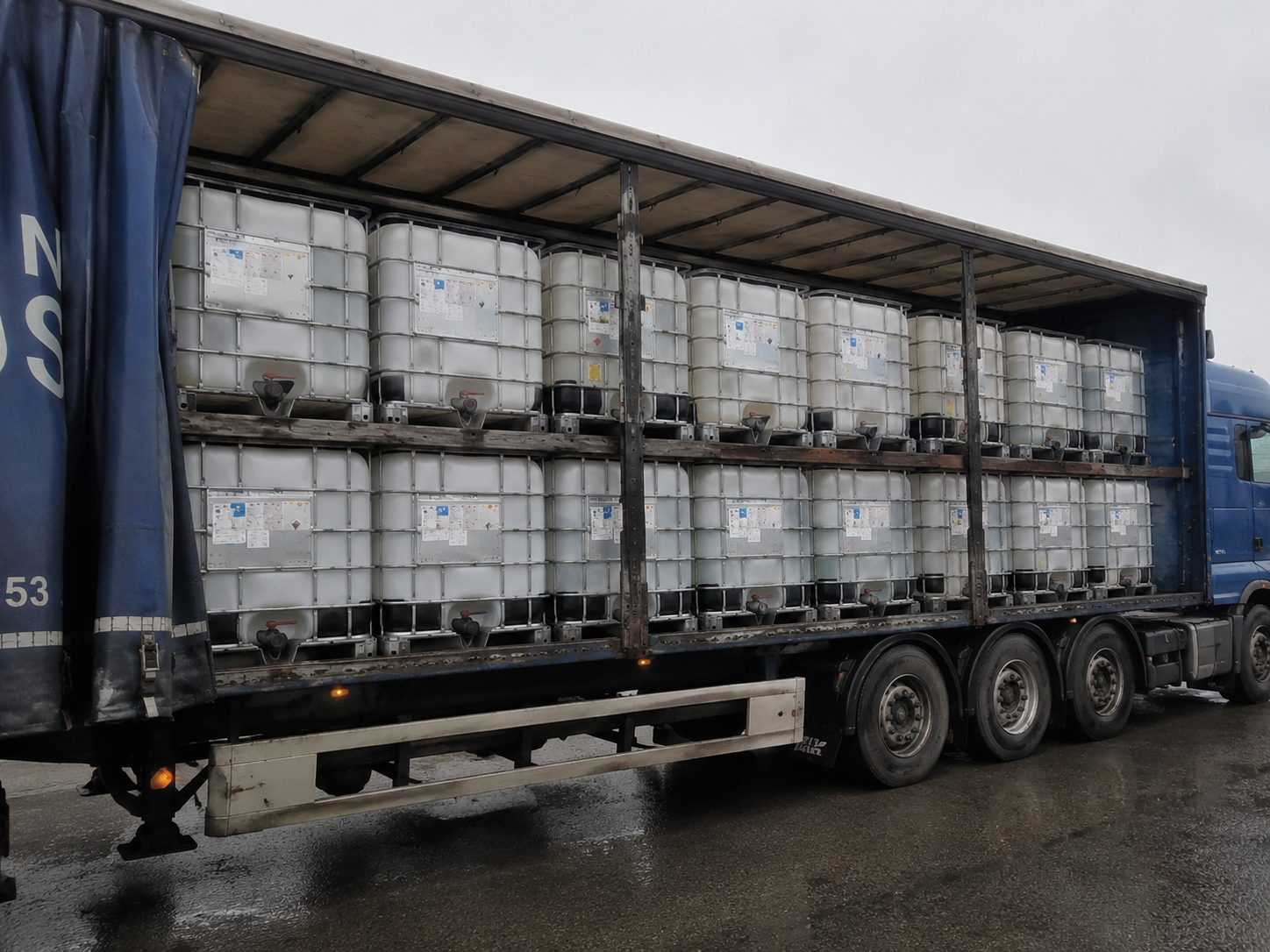
We started by buying piles of perfectly usable tanks that were on their way to a baler. The business has grown a lot — but the floor philosophy is unchanged.
The first IBC Recycle USA "facility" was a corner of a leased warehouse off Industrial Parkway. Our founder had spent fifteen years in industrial packaging and had watched a hundred-tank pile of perfectly-good totes get run over by a Bobcat outside a chemical plant in Columbus. The bottles were chemical-free, the cages were straight, the valves still seated. They went to a baler because the plant didn't have a buyer for them on file.
He bought the next pile. Then the one after that. Within eighteen months the "corner of a warehouse" was its own warehouse and we'd picked up our first wash bay.
Reselling clean tanks gets you a margin. Reselling reconditioned, requalified, recertified tanks — with a paper trail — gets you contracts. We invested in a four-stage caustic wash line, leak-test rigs, and a small in-house lab so we could put a real grade on every unit that left the dock. The grading system we still use today (Bottle / Wash / Rebottle / Recon) was written on a whiteboard that summer.
A reconditioned tote that costs $40 to ship 800 miles isn't much of an eco-story. We partnered with regional carriers to run consolidated milk-runs across the Midwest, then the Mid-Atlantic, then Texas, then the West Coast. Today, the typical reused tank we deliver has shared a trailer with 19 others headed in the same direction. Lower carbon, lower price, fewer empty miles.
A small percentage of incoming tanks can't be requalified — usually because the bottle has stress-cracked or the contents were aggressive enough to scar the polymer. For years, those went to scrap. In 2021 we built our own grind line so that any HDPE we can't put back into service comes out as clean, uniform flake we can sell directly to molders. Zero-landfill on incoming tanks has held since.
We've grown a lot, but the floor philosophy hasn't changed. We buy what others are about to bale. We wash, requalify, and re-circulate the units that can take another life. We grind the units that can't. We don't mold virgin plastic when reused will do — which, honestly, is almost always.
Reselling clean tanks as-is was a fine business, but it left margin on the table and let inconsistent units leak into the supply chain. We took out a second lease two doors down from the original warehouse and built our first dedicated wash bay — hot water, caustic dosing rig, simple gravity drain to a holding tank, and an exterior pressure washer for the cages. That summer was the first time we shipped tanks with a written grade card instead of a verbal description on the BOL.
For the first three years, our founder did most of the intake grading himself. By 2012 the volume had outgrown one person, and we made the first dedicated quality hire — a chemical engineering tech who had spent ten years in industrial container audit at a regional cleaning-products manufacturer. His first six months consisted mostly of rewriting our intake protocols to be reproducible by someone other than the founder. Most of the grading rubric we use today traces back to that work.
We took the leap into formal UN requalification for the reconditioned hazmat-eligible line in 2015, after about eighteen months of consultation with a DOT compliance attorney and one of our larger industrial chemical customers. The investment in pressure-test infrastructure and documentation systems was significant — roughly six months of payroll for the team that built it out — and immediately opened up the regulated chemistry segment that had been technically off-limits to us before.
A Midwest industrial cleaner manufacturer approached us in late 2017 about running their entire packaging fleet as a closed loop. Up to that point, our largest single customer ran maybe forty tanks a month through us; this proposal was for a thousand. We spent eight months designing the program — the dedicated pool size, the reverse-logistics consolidation, the monthly reporting cadence — and launched in summer 2018. It is still running today, with the third generation of the original customer's purchasing team having taken it over from the people who signed the original contract.
When COVID-19 hit, we braced for the worst — industrial container demand was supposed to crash. Instead, the cleaning and sanitation segment exploded. Customers who had been shipping a few hundred tanks a year of disinfectant suddenly needed thousands, and they needed them fast. We hired temporarily, ran the wash line at extended hours, and delivered. The 2020 spike permanently reset the conversation about what reconditioning capacity meant to industries that thought of themselves as "always using new" before the supply chain disruption taught them otherwise.
We took our phone number off the website in 2022. It was controversial internally and externally for about a quarter. By the end of 2022, response times had dropped, quote accuracy had improved, and customer satisfaction scores had moved up. The long version of why we did it is documented on the blog.
Our biennial Verde Compliance Partners audit covering 2022 and 2023 confirmed eight consecutive years of zero landfill on incoming IBCs. That was a milestone we had quietly been tracking for years — the first audit we ran in 2016 was meant to give us a baseline, not a streak, and the streak just kept going. We continue to publish the methodology and audit summary on our sustainability page.
The original observation — that perfectly usable tanks were being baled because nobody was set up to route them to a second life — is still the operating premise of the company. The systems have gotten more sophisticated, the documentation more rigorous, the geographic reach broader. But the core economics, and the core ecological argument, are the same as they were when our founder bought the first pile of empty totes from a chemical plant outside Columbus fifteen years ago.
The industry has very few written-down-honestly accounts of what reconditioning companies got wrong on the way up. Here are three of ours, on the record.
Our first grade-card system, in 2009, was a three-color sticker — green, yellow, red. It told customers very little and confused our own ops team. The second iteration (2011) introduced the four-tier nomenclature (Bottle / Wash / Recon / Food), but the definitions were vague and the inspectors disagreed regularly. The third iteration (2013) tightened acceptance criteria for each grade, added the "Rebottle" tier between Wash and Reconditioned, and is essentially the system we still use today.
For the first six years, we ran more aggressive caustic concentrations than necessary for most chemistries — a hangover from our founder's background in heavy industrial cleaning. The lesson, gradually, was that wash chemistry should be tuned to the prior-contents class, not run hot across the board. Today we maintain four distinct caustic recipes calibrated to different residual categories. Our water and energy use per tank has dropped roughly 35% from the early years.
For most of the first decade, we treated empty-tote pickup as a transactional service that we offered to customers who asked. That cost us volume — the math of consolidated freight only works at scale. Around 2017 we started thinking about reverse logistics as the central business function it actually is, and the company grew significantly faster after that shift.
Several times across the past decade we have evaluated opening a second facility — most seriously in 2019 and again in 2023. Each time the math suggested that the discipline of running a single operation outweighed the freight savings of regional presence. We have stayed in Dublin, Ohio, and we have invested instead in consolidated freight networks that move tanks across the country at competitive rates.
The trade-off is honest: customers in the Mountain West and the Pacific Northwest pay slightly more per tote in landed freight than they would from a hypothetical regional reconditioner. In exchange, every tank they receive has been through the same process, graded by the same inspectors, and washed under the same protocols. For most of those customers, the consistency is worth more than the freight delta. The customers who disagree have not stayed with us, and that is a perfectly legitimate outcome.