01
Home
A standalone page — no sub-sections.
A 275-gallon IBC is roughly 130 lbs of HDPE and 28 lbs of galvanized steel. Every time we put one back into service, that's the math we erased from the world.
Tell us what you need or what you have. We respond within one business day, every business day.
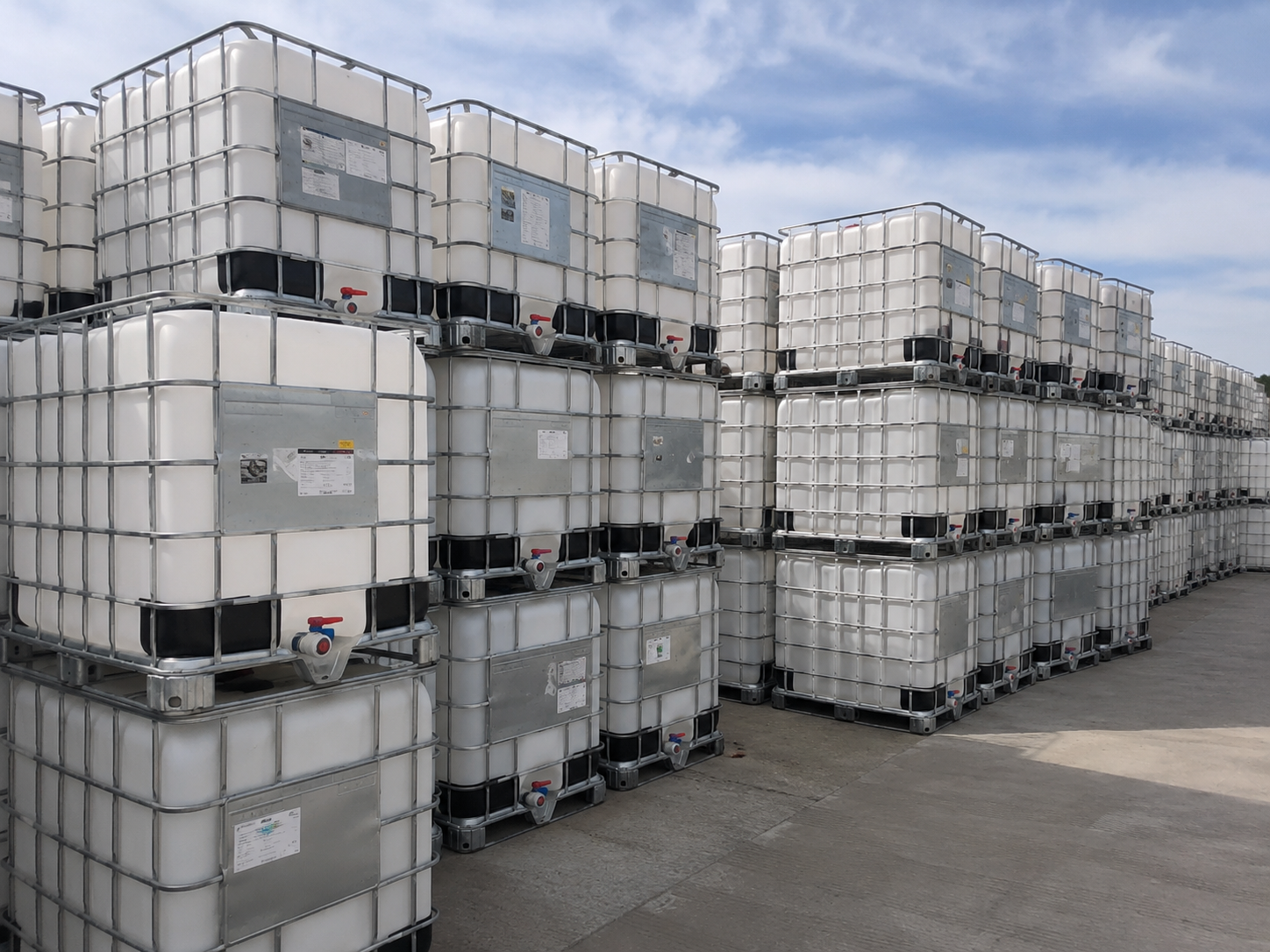
From incoming totes that were reconditioned (1,612 T) and end-of-life that went to flake (235 T).
Versus a virgin-HDPE / virgin-steel baseline using EPA WARM v15 emissions factors.
Share of incoming tanks that re-entered service as a commercially-filled IBC.
Eight consecutive years. Audited by Verde Compliance Partners, last cycle: Q1 2024.
When a 275-gallon IBC goes back out to a commercial filler after reconditioning, we count it as an avoided new tank only if the receiving customer has historically purchased new units for similar service. We don't double-count tanks that move inside our own reconditioning loop multiple times in the same year.
Per-tote embodied emissions baseline: 318 kg CO₂e (130 lbs virgin HDPE @ 2.0 kg CO₂e/kg + galvanized steel cage @ 2.4 kg CO₂e/kg + hardwood pallet + manufacturing overhead). Our reconditioning footprint per tank (water heat, caustic, electricity, transport to/from wash line) is roughly 24 kg CO₂e — a net savings of ~294 kg per re-circulation. Multiplied across the year's reconditioned volume, that's where the 9.6M figure comes from.
For incoming tanks specifically: every IBC that arrives at our Dublin facility is either (a) reconditioned and re-sold, (b) parted out for cage/valve reuse, or (c) ground for HDPE flake that we sell to molders. None go to a landfill. This claim is audited every other year by an outside firm.
We'll update this page annually and link the audit summary the moment it's public.
Year-by-year diversion numbers tell one story. The cumulative numbers tell a different one: the compounding effect of keeping the same polymer in circulation across multiple fill cycles per tank, across many tanks per year, across many years.
| Year | HDPE diverted (metric tons) | CO₂e avoided (kg) | 2nd-fill rate |
|---|---|---|---|
| 2024 | 1,847 | 9,600,000 | 94% |
| 2023 | 1,712 | 8,900,000 | 93% |
| 2022 | 1,564 | 8,100,000 | 91% |
| 2021 | 1,401 | 7,200,000 | 90% |
| 2020 | 1,318 | 6,800,000 | 89% |
| 2019 | 1,156 | 6,000,000 | 87% |
| 2018 | 1,022 | 5,300,000 | 86% |
| 2017 | 872 | 4,500,000 | 84% |
| Cumulative | 10,892 | 56,400,000 | — |
Numbers prior to 2017 exist but were not measured under a methodology consistent with current EPA WARM-aligned reporting, so we do not include them in the cumulative headline. The current methodology has been retroactively applied back to 2017.
For sustainability teams who need to audit our claims against their own internal standards, here is the full per-tank carbon math we use.
318 kg (avoided new-unit production) − 24 kg (reconditioning footprint) = roughly 294 kg CO₂e per reconditioned tank. Multiplied by the annual throughput where reconditioned units genuinely displaced new-unit purchases, that is where the headline annual number comes from.
We do not count tanks that cycle within our own closed-loop programs more than once per calendar year toward the avoided-new-unit baseline — the second cycle is a real ecological benefit, but it is not a separate avoided new tank, and counting it as one would inflate the headline number against the methodology. We also do not count tanks shipped to customers whose historical purchase pattern was already heavy on reconditioned (since the tank did not, in that case, displace a new-unit purchase).
Carbon is the headline. It is not the only number. A complete environmental accounting for a reconditioning operation has to cover water use, energy use, and the chemistry we put into and take out of the wash line.
Each reconditioning cycle consumes roughly 35 gallons of water — wash, neutralization rinse, and exterior cleaning combined. Across our 2024 annual throughput that is roughly 2.2 million gallons. Our facility includes an on-site treatment system that neutralizes pH, settles solids, and discharges to the municipal system within Ohio EPA permitted parameters. We meter and report water draw monthly.
Facility electricity consumption in 2024 was roughly 1.8 GWh, with another 280,000 therms of natural gas for wash water heating. The carbon footprint of this energy is baked into our per-tank reconditioning math; the regional grid mix (PJM) is dirtier than we would like, and we are evaluating on-site solar for a 2026 or 2027 install.
Caustic and acid for neutralization, used in carefully metered concentrations, fully neutralized in the treatment system before discharge. We have moved away from surfactant-heavy wash recipes over the past several years toward longer-dwell caustic cycles — same cleaning outcome with substantially less ongoing chemistry use.
Steel cages and steel pallets from end-of-life tanks: sold to local scrap dealers with documented chain of custody. Hardwood pallets: shredded for landscaping mulch supply or used as boiler fuel by a regional partner. Total facility tipping-fee landfill contribution in 2024: under one ton, almost entirely office and break-room waste.
The phrase "closed-loop" has been used loosely enough in industrial packaging marketing that we want to define what we mean by it specifically.
A genuine closed-loop IBC program requires four things, all of them operating in concert. Most claims of "closed-loop" fail one or more of these tests.
A program that does three of these well but skips the fourth — the most common failure mode — produces good operating outcomes but cannot back up the sustainability claims it would like to make. We have rebuilt several customer programs in our history specifically to fix this gap.