01
Home
A standalone page — no sub-sections.
Pick the lane that matches what you have or what you need. Most relationships start in one and grow into two or three.
Tell us what you need or what you have. We respond within one business day, every business day.
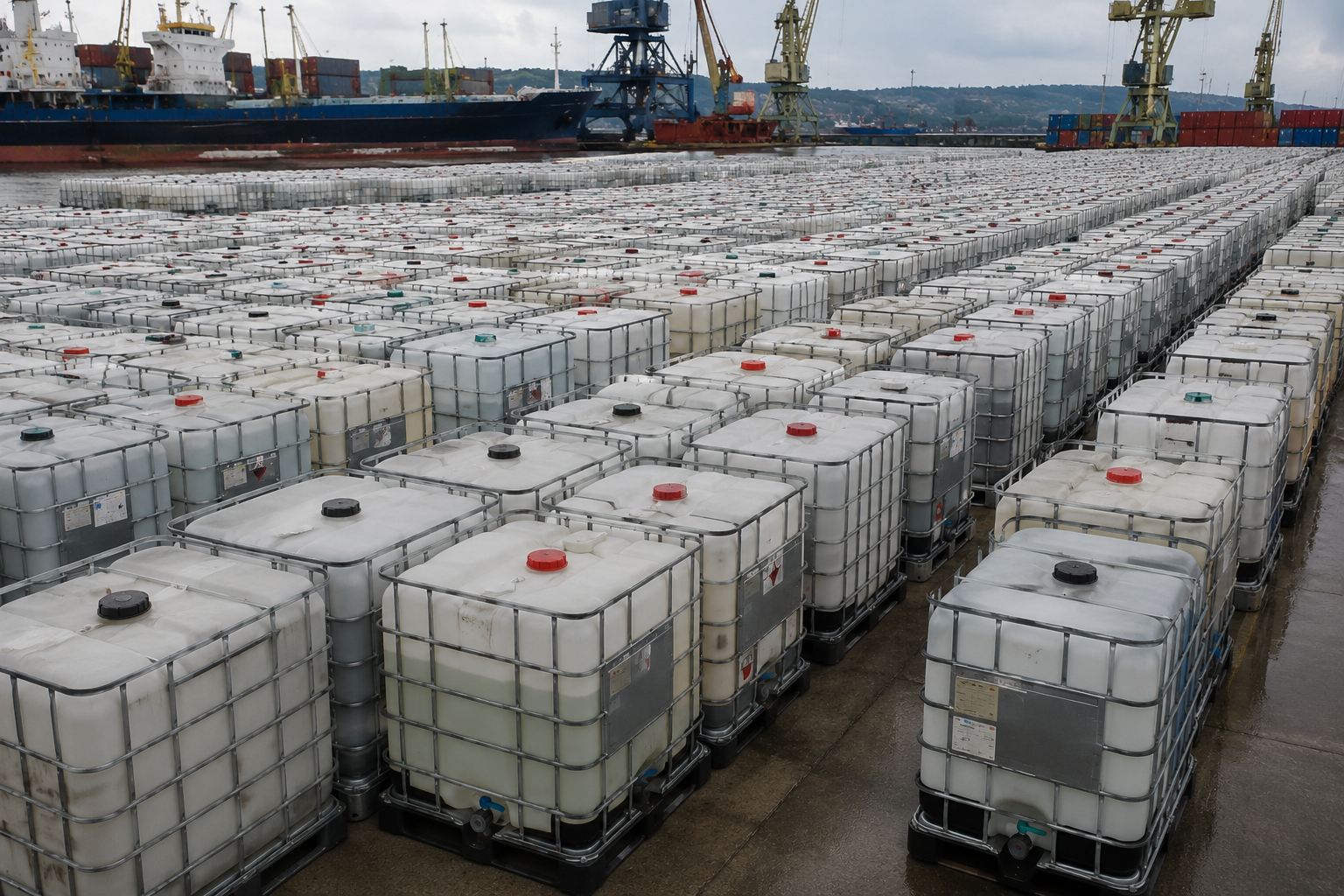
Reconditioned, new, or rebottled. Single pallet to full truckload. Nationwide delivery.
We pay for empty totes nationwide and schedule the pickup. Turn dead inventory into revenue.
End-of-life HDPE recovery for tanks that cannot be reused. Audited, zero-landfill.
Wash, requalify, recertify your own tank fleet — or send us yours and we'll do it.
Consolidated regional lanes mean fewer empty miles and lower freight per tote.
Dedicated programs for high-volume generators with audit-grade sustainability reporting.
The typical relationship with us starts in one lane — usually buying reconditioned tanks — and grows over time into two or three connected services. Here is how the common patterns shake out.
The most common starting pattern. Customer buys reconditioned tanks, fills and ships them downstream. After product use, the tanks accumulate as empties at downstream distribution points. Within a year or two, the customer asks if we can pick those empties up — and we extend the relationship into our buyback service. Net result: the customer's packaging supply becomes a quasi-closed-loop without any formal program structure.
Less common but real: a customer with accumulating empties on their dock approaches us for buyback. After a few transactions, they realize they could be buying tanks from us for their next production fill rather than from a new-tank supplier — at significantly lower cost. The buyback relationship migrates into a buying one.
For customers with monthly throughput above roughly 200 totes, the transactional buying relationship eventually evolves into a custom closed-loop program. The economics tip decisively in favor of the dedicated-pool model at that scale, and the operational simplicity of a single invoice and a single reporting cadence beats the one-quote-at-a-time alternative.
Some customers approach us for transport services exclusively at first, often during a peak shipping period. Once the relationship is in place, the conversation broadens to reconditioning the tanks during the off-peak window, and the relationship evolves from logistics-only into reconditioning-plus-logistics.
We are deliberately narrow in scope. Here is what we explicitly do not offer, and the reasoning.
Across all six service lines, here is what we commit to and how we measure it internally.
| Metric | Target | Recent actual |
|---|---|---|
| First reply to new inquiry | ≤ 1 business day | ~6 business hours |
| Written quote turnaround | ≤ 1 business day | ~10 business hours |
| Stock order ship time | 3–7 business days | 4.5 business days avg |
| Custom or non-stock order | 10–30 business days | 14 business days avg |
| Empty pickup scheduling | ≤ 10 business days | 6 business days avg |
| Lot documentation delivery | Before truck arrival | ~99% on time |
| Customer dispute resolution | ≤ 2 business days | ~95% on time |
How do I get started if I just have empty totes to move? Use any form on the site with your tote count, prior contents, and location. If they are sellable we quote a buyback; if not, we route them to audited recycling.
Do I have to commit to a recurring program? No. Most relationships start as one-time transactions — buying a pallet or selling a load. Recurring closed-loop programs are optional and usually grow out of that first transaction.
Can I combine several services? Yes, and most customers do. Buying and sell-back naturally pair into a quasi-closed loop; transport folds into reconditioning. We invoice and report across the combined relationship.
Is there a phone number to call? No. We run phone-free by design — written exchanges produce more accurate quotes and a clean paper trail. We reply to every inquiry within one business day.
When does a custom closed-loop program make sense? Roughly above 200 totes per month of sustained throughput, where the dedicated-pool economics and single reporting cadence beat transactional buying.