01
Home
A standalone page — no sub-sections.
Long-form writing on regulations, sustainability, case studies, logistics, and operations. Updated as the calendar allows.
Tell us what you need or what you have. We respond within one business day, every business day.
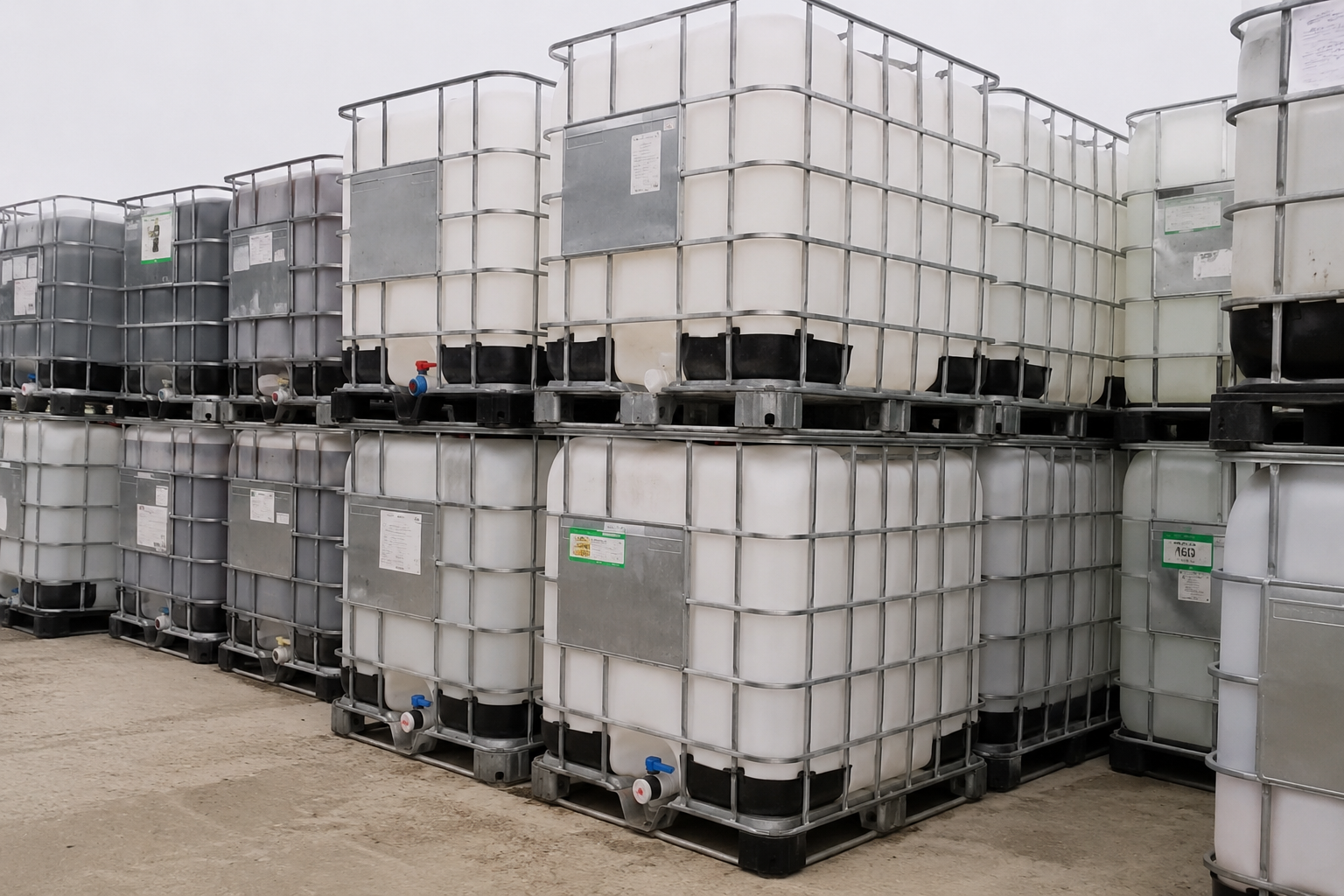
A reconditioned 275-gallon IBC matches the functional performance of a new one at roughly one-third the cost and one-tenth the embodied carbon.
Read post →A walkthrough of caustic wash, neutralization, leak test, valve service, and the rest of what separates a reconditioned tank from one that was just hosed out.
Read post →What UN31HA1/Y actually means on a tote — and when the alphabet soup on the side of your IBC matters for shipping paperwork.
Read post →How high-volume IBC generators are cutting packaging cost 30–45% and getting clean sustainability numbers at the same time.
Read post →The break-even between a fleet of drums and a fleet of IBCs is closer than most ops managers think — and the secondary effects on safety and handling time are even bigger than the headline cost gap.
Read post →When a bottle finally can't be requalified, what actually happens to the polyethylene? A grounded walkthrough of the recovery, wash, and pelletization chain.
Read post →A look at the first 90 seconds of a tote's second life — the visual inspection, label review, and contents check that decides which grade it qualifies for.
Read post →A short list of warehouse-and-yard rules that, in our experience, prevent almost every common IBC storage incident — from valve drips to stack collapses.
Read post →What separates a food-grade tote from an industrial one, what documentation you should require, and where reused units are perfectly acceptable.
Read post →Stack ratings are written in a vocabulary that obscures what they actually allow. Here is what they mean in pounds, in real warehouses.
Read post →Why both formats max out at 80 units per 53-foot trailer, what that means for your freight rate, and when the 330 actually saves money.
Read post →Ball vs. butterfly, two-inch vs. three-inch, EPDM vs. Viton — what each option actually changes about how the tote operates.
Read post →When the regulation requires it, what counts as compliant, and the cheapest path to a fully-compliant storage area.
Read post →Which products in IBCs actually freeze, which thicken, and which become structurally hazardous in a cage that's been sitting outdoors at -10°F.
Read post →Every IBC bottle failure we have ever seen falls into one of three categories. Knowing which to watch for is most of the prevention.
Read post →A short-form decision tree for buyers trying to decide whether stainless, carbon-steel, or HDPE is the right tote for a given service.
Read post →A look at the actual freight math behind consolidated empty-tote pickup, and why a serious reverse-logistics commitment is the entire game.
Read post →Three of the chemistries we recondition most often — surfactants, glycols, mild acids — each require a distinct wash recipe. Here is what we do for each.
Read post →Where exactly the 2.0 kg CO₂e per kilogram of virgin HDPE comes from, and what that means in tote terms.
Read post →How seasonal liquid-fertilizer demand shapes the ag-IBC market — and why the spring rush is the worst time to wait.
Read post →Personal-care manufacturers have spec language that reads like food service but tolerates reconditioned tanks better than they let on.
Read post →Most agricultural pesticides are compatible with reconditioning. A short list is not. Knowing the difference matters.
Read post →Three years ago we took our phone number off the website. Here is what changed, what we learned, and why we have no plans to put it back.
Read post →The EPA's WARM model is the U.S. de-facto standard for diversion accounting. Here is how to apply it to your IBC tote program.
Read post →Tamper-evident seals are required for some applications, optional for most, and overkill for the rest. Here is the practical decision guide.
Read post →October is the right month to winter-prep a tote fleet. Here is the checklist that prevents January incidents.
Read post →A guide for procurement teams who want to allow reconditioned containers without re-opening every product-quality conversation.
Read post →A real customer (anonymized) cut packaging cost 38% and HDPE footprint 91% by switching to a closed-loop IBC pool. Here is how the program was structured.
Read post →Consolidated freight is how we keep per-unit transport cost (and carbon) under control. Here is what that actually looks like in dispatch.
Read post →For food-facility intake of IBCs holding food ingredients, FSMA requirements are narrower than most procurement teams assume.
Read post →For the small share of applications where either an IBC or a 55-gallon poly drum could work, here is the lifecycle math for both.
Read post →A character-by-character walkthrough of the UN marking on the side of a typical IBC, and what each piece tells you.
Read post →How a regional water-treatment cooperative built an IBC program around the operational quirks of municipal procurement.
Read post →Headline diversion tonnage is a vanity metric. Second-fill rate — the share of intake that returns to commercial service — is what actually drives sustainability impact.
Read post →Looking for something specific? Try the FAQ or the grading system page.