01
Home
A standalone page — no sub-sections.
Wisconsin sits on our multiple times per week lane network. Tanks reach WI ZIP codes within 4–6 business days of pickup from our Dublin, Ohio yard — consolidated freight that keeps per-tote freight cost and carbon footprint substantially below direct-truck rates.
Tell us what you need or what you have. We respond within one business day, every business day.
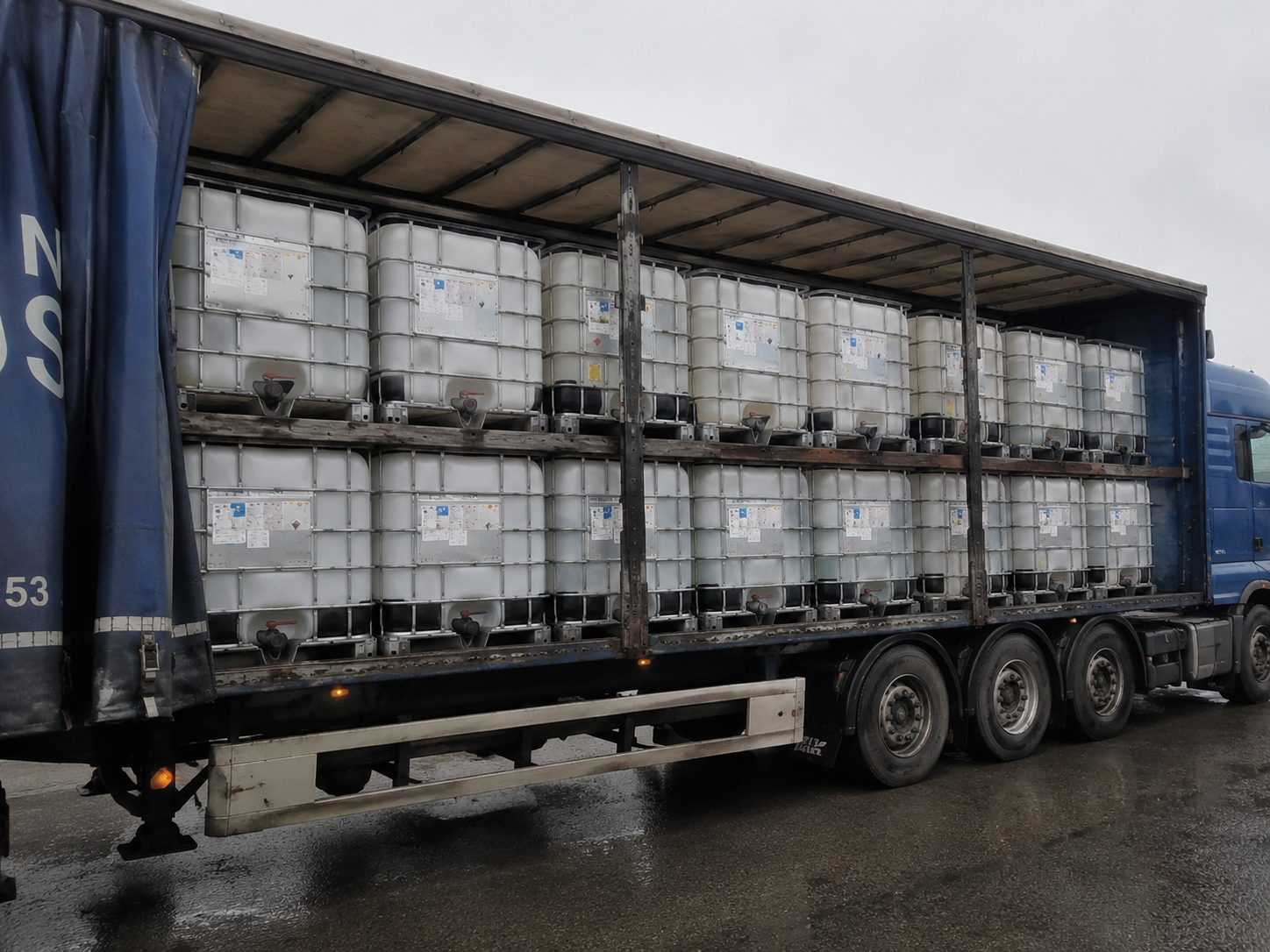
Wisconsin sits roughly 460 miles from our Dublin, Ohio facility. We serve WI on a multiple times per week cadence, with typical lead times of 4–6 business days from pickup at our yard to delivery at your dock. For high-volume customers, we run dedicated consolidation lanes that shave additional time off the standard cycle.
Customers in Wisconsin typically span the following industrial segments:
Below is the major-city coverage for Wisconsin. We ship to all ZIP codes in the state, not only those listed — but these are the metros where we run the most volume and where our consolidated lanes pass most frequently.
Milwaukee MSA
Industrial chemistry, Beverage.
Madison MSA
Research chemistry, Pharma intermediates.
Green Bay MSA
Paper chemistry, Food & beverage.
Chicago MSA
Industrial chemistry, Manufacturing.
Appleton MSA
Paper chemistry, Industrial chemistry.
Most Wisconsin customers run one of two relationships with us. Below is the short form of each.
For one-off purchases or low-volume recurring needs (1–40 tanks at a time), we run standard consolidated freight to your Wisconsin destination. You submit an inquiry, we quote, you approve, we ship. Lead time runs 4–6 business days for standard reconditioned inventory; specialty grades may add 5–10 business days.
For Wisconsin customers running 200+ tanks per month sustained, a closed-loop program is almost always the right structure. Dedicated tank pool, scheduled reverse-logistics recovery from your downstream points, scheduled reconditioning, and monthly carbon and throughput reporting. We have multiple closed-loop programs running across Midwest today.
Wisconsin customers with accumulating empty totes on their docks can sell them back to us. We schedule pickup on our existing consolidation lanes through the region, pay fair market rates per tank grade, and provide diversion certificates for your sustainability reporting. Typical buyback pickup window: 5–10 business days from quote acceptance.
A few things worth knowing about IBC operations in Wisconsin specifically:
Wisconsin follows federal 49 CFR for hazmat IBC shipping. State environmental regulations may add additional requirements for secondary containment of hazardous chemistry storage at your facility — typically aligned with EPA RCRA and SPCC at the federal level. We can provide documentation that satisfies most state inspections; for state-specific edge cases, talk to your environmental compliance counsel.
Winter shipping (December through February) in Wisconsin requires attention to product freeze risk for water-based chemistry. Heated or insulated transport is available on request. Outdoor staging of empty totes is fine; loaded tanks should move indoors before sustained sub-freezing weather.
What is the typical lead time to Wisconsin? 4–6 business days from order acceptance to delivery at most WI ZIP codes, assuming standard reconditioned stock.
Do you have a Wisconsin warehouse? No — we operate from a single facility in Dublin, Ohio. Our consolidation network lets us deliver to Wisconsin at competitive freight rates without maintaining a regional yard.
Can you handle hazmat shipments to Wisconsin? Yes. UN-requalified reconditioned IBCs ship with full hazmat documentation. Carriers on our hazmat lanes are appropriately certified.
Do you ship to cross-state addresses near Wisconsin? Yes. If your address sits near the Wisconsin border, we route through whichever lane gets your shipment to you most efficiently regardless of state line.
What about pickups of empty tanks? Empty pickups run on the same lanes as deliveries — usually within 5–10 business days of quote acceptance.
How do Wisconsin sustainability incentives interact with reused IBCs? Wisconsin customers running closed-loop programs with us frequently use the diversion tonnage we report as a credited line in their state-level sustainability disclosures. Methodology aligns with EPA WARM.
Many of our Wisconsin customers also have operations or distribution into neighboring states. Lane consolidation is often most efficient when freight crosses state lines on the same trip. Common adjacent destinations: